Lien zoom du symposium:
https://kwansei-gakuin.zoom.us/j/95373356431?pwd=hcPaxp8xdo8d7Vak0tVvFLCbOwH8eQ.1
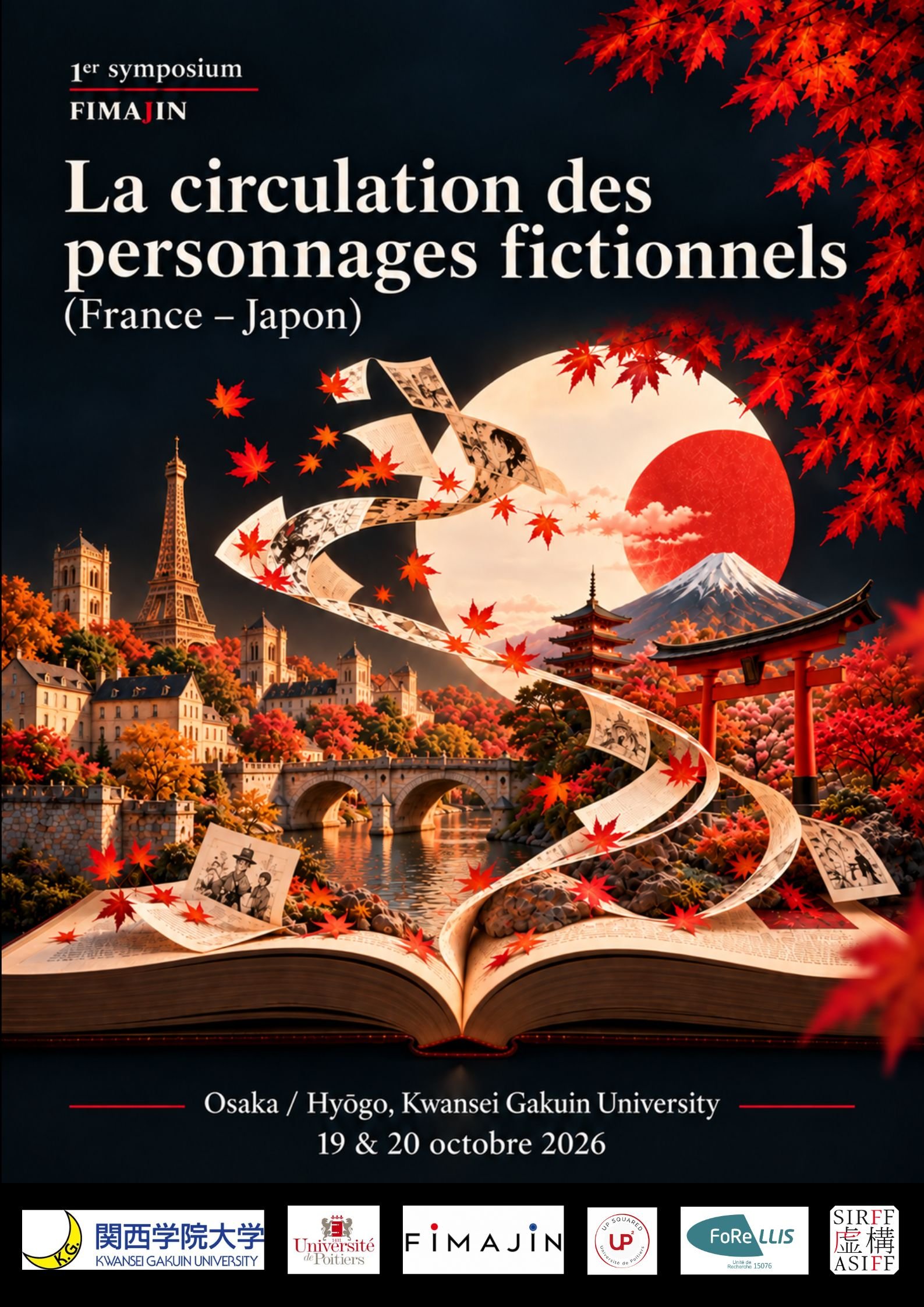
La circulation des personnages fictionnels (France–Japon)
1er symposium FIMAJIN
Osaka / Hyōgo, Kwansei Gakuin, 19 & 20 octobre 2026
--> Accessible en ligne; demandez le lien à charlotte.krauss@univ-poitiers.fr à partir du 12 octobre
PROGRAMME
✼ Lundi, 19 octobre 2026 ✼ [Kwansei Gakuin University – Campus
Osaka Umeda : Osaka-shi, Kitaku, Chaya-machi 19-19, Osaka, Applause Tower,
salle 1403]
|
10h
|
Ouverture
|
|
10h15
|
Kohei TAKAHASHI
Transfictional Characters Without Their Names
|
|
11h45
|
Pause repas
|
|
13h00
|
Françoise LAVOCAT
Métalepses et circulation des
personnages au tournant du XXe et du XXIe siècle
|
|
14h30
|
Pause café
|
|
14h45
|
Denis MELLIER
Arsène Lupin et les métamorphoses du Kaitō : perspectives transmédiales
|
|
16h15
|
Pause café
|
|
16h30
|
Jessy ESCANDE
Hybridation culturelle d’un imaginaire fantastique
|
✼ Mardi, 20 octobre ✼ [Kwansei Gakuin University – Campus Uegahara :
Nishinomiya-shi, Uegahara Ichiban-cho 1-155, Hyogo, bâtiment daï-ichi kyoju
kenkyu-kan, salle 1]
|
10h00
|
Simone MULLER
Du héros à l’oisif : les multiples visages de Momotarō à
travers les contextes historiques et culturels
|
|
11h30
|
Pause
repas
|
|
13h00
|
Naoko MORITA
Masahiko AMAKASU (1891–1945) en tant que personnage fictionnel
|
|
14h30
|
Pause
café
|
|
14h45
|
Akihiro KUBO
Les personnages fictionnels à l’ère de la
transmédialité : perspectives japonaises et comparatistes
|
|
16h15
|
Pause
café
|
|
16h30
|
Charlotte KRAUSS
Circuler en dehors des récits. Personnages de bande dessinée et de manga dans
les parcs d’attraction (France–Japon)
|
La
circulation des personnages fictionnels (France–Japon)
1er
symposium FIMAJIN
Osaka /
Hyōgo, Kwansei Gakuin, 19 & 20 octobre 2026
Les
personnages fictionnels ne restent pas à leur place. Ils traversent les œuvres
qui les ont vus naître, migrent d’un médium à l’autre, changent de culture et
circulent entre existences narratives ou interactives et présences sociales ou
performatives. Du roman à l’image, de l’animation au jeu vidéo, du livre à la
scène ou à l’espace public, ils peuvent être traduits, réinterprétés,
patrimonialisés ou incarnés. Certains deviennent des figures transnationales,
tandis que d’autres se transforment profondément au contact d’un nouvel
imaginaire culturel. Les personnages ne circulent pas seuls : ils voyagent avec
les affects, les attachements et les formes d’identification qu’ils suscitent.
Le premier
symposium FIMAJIN explore ces phénomènes sous le concept de circulation des
personnages fictionnels, dans une perspective comparative entre la France et le
Japon, avec une attention particulière à deux moments charnières : 1870–1910 et
1990–2025. La notion de circulation dépasse ici le seul modèle linéaire de
l’adaptation d’un récit vers un nouveau support. Elle désigne un ensemble de
dynamiques plus complexes : déplacements entre médias au sein d’un même
écosystème ou d’un même monde fictionnel, transferts culturels, réécritures
transhistoriques et appropriations par les publics. L’enjeu est d’interroger la
manière dont un personnage conserve, transforme ou reconfigure son identité
lorsqu’il change de contexte matériel, esthétique ou culturel, et comment ces
déplacements produisent de nouvelles significations en redéfinissant les
contours mêmes des mondes fictionnels auxquels il appartient.
Le choix de
la France et du Japon permet de mettre en regard deux traditions
particulièrement riches de récit visuel et sériel. Entre 1870 et 1910, l’essor
de la presse illustrée, des formes narratives graphiques et du cinéma inaugure
une première modernité médiatique dans laquelle les personnages commencent déjà
à circuler entre supports. Un siècle plus tard, entre 1990 et 2025, la
numérisation, la mondialisation des industries culturelles et l’émergence de
logiques de franchise intensifient et complexifient ces circulations. Les
personnages deviennent les pivots d’univers transmédiatiques et les vecteurs
d’imaginaires transnationaux, tout en restant ancrés dans des traditions
culturelles spécifiques.
En plaçant le
personnage au centre de l’analyse, le symposium déplace le regard des œuvres et
des médias vers un élément structurant de la fiction. Le personnage apparaît à
la fois comme un opérateur de cohérence et de mémoire au sein de mondes
fictionnels pluriels, et comme un lieu de négociation entre imaginaires
culturels, affects collectifs et cadres sociaux. Son identité, sa
reconnaissance et les attachements qu’il suscite se reconfigurent au gré de ses
passages entre époques, médias et aires culturelles. Une attention particulière
est également portée aux formes de circulation propres aux cultures graphiques,
audiovisuelles, sérielles, performatives et participatives.
Le symposium
entend ainsi contribuer à une compréhension dynamique des circulations
historiques et contemporaines de la fiction, en faisant dialoguer les
traditions scientifiques françaises et japonaises autour des transformations
des personnages, des mondes fictionnels et des pratiques qui leur donnent de
nouvelles formes d’existence.
Résumés
Jessy ESCANDE (Université Métropolitaine Osaka)
Hybridation
culturelle d’un imaginaire fantastique : dissolution de l’historicité des
motifs étrangers et internalisation par la culture populaire japonaise
Nos
recherches portent depuis plusieurs années sur les processus de transfert
culturel à travers lesquels des motifs issus de folklores, mythologies et
religions du monde entier ont été intégrés dans la culture populaire japonaise,
en particulier dans le genre que nous avons défini comme le database fantasy
(Escande 2021). Ce genre, qui s’est développé à partir des années 1980, se
caractérise par un répertoire de motifs étrangers — du carbuncle sud-américain
à la goule arabe, du catoblepas gréco-éthiopien au Dullahan irlandais —
largement internalisés par les créateurs et consommateurs japonais, au point
que leur extranéité n’est plus perçue : pour les récepteurs japonais, dont
l’encyclopédie culturelle les intègre sans activer leur historicité, ils sont
mobilisés comme des éléments endogènes d’un imaginaire fantastique dont ils
constituent pourtant l’apport exogène (Escande 2022a, 2022b, 2023a, 2025a). En
retraçant les parcours de ces motifs à travers leurs passeurs culturels
— des bestiaires médiévaux au Livre des êtres imaginaires de Borges, des
TRPG tels que Dungeons & Dragons aux dictionnaires japonais du
fantastique —, nous avons mis en évidence une dynamique que le champ conceptuel
des transferts culturels, issu des travaux d’Espagne et Werner (Espagne
& Werner 1988 ; Espagne 2013), permet de saisir : la culture
réceptrice ne reçoit pas passivement, mais sélectionne, transforme et
re-sémantise les matériaux importés.
La
présente communication propose de franchir une étape théorique en articulant
cette dynamique de transfert avec le cadre sémiotique d’Umberto Eco,
prolongeant ainsi notre article récent sur la réception culturelle comme
re-sémiosis (Escande 2025b). Notre concept central sera celui de dissolution
de l’historicité : le processus par lequel les interprétants
historiques attachés aux motifs étrangers cessent d’être activés dans l’encyclopédie
(au sens d’Eco) des récepteurs japonais. Le motif ne perd pas sa généalogie —
celle-ci reste recouvrable pour qui la cherche — mais le réseau encyclopédique
a été reconfiguré de telle sorte que les parcours interprétatifs menant au
référent culturel d’origine (folklorique, mythologique, religieux) sont
supplantés par ceux internes au genre du fantastique japonais contemporain, ou
plus étroitement, du database fantasy, que nous avons défini comme un
genre spécifique au contexte japonais contemporain. C’est précisément cette
reconfiguration qui permet aux motifs de fonctionner comme un catalogue de
signes mobilisables sans connaissance préalable de leurs origines, constituant
ce que nous avons proposé d’appeler une encyclopédie transversale :
plus étroite que l’encyclopédie médiane d’une culture, mais plus large qu’une
encyclopédie spécialisée, car elle traverse les sous-genres et les médias.
Pour
approfondir cette théorisation, nous mobilisons la notion de créolisation
(Glissant 1990 ; Hannerz 1987 ; Amselle 1990), non pas comme
catégorie descriptive, mais comme concept-limite. Le parallèle
structural est productif : de même que le créole devient la langue
maternelle de la génération suivante, qui ne l’éprouve plus comme langue de
contact, les motifs fantastiques étrangers sont devenus, pour les récepteurs
japonais de deuxième et troisième génération (la première possédait bien une
connaissance historique des motifs), des éléments natifs d’un imaginaire qu’ils
n’interrogent plus comme hybride. Toutefois, nous prenons soin de ne pas
assimiler les deux contextes : la créolisation glissantienne est
indissociable de l’expérience de la plantation et de l’asymétrie du contact
forcé, là où l’appropriation japonaise relève largement d’un processus
souverain d’importation sélective. La créolisation nomme ici un horizon
— le point théorique vers lequel tend la dissolution de l’historicité sans
nécessairement l’atteindre au sens fort. L’écart même entre l’effet fonctionnel
(le signe opère comme natif) et la généalogie encore traçable constitue un
objet d’analyse.
La
dimension comparative France–Japon, chère au projet FIMAJIN, s’inscrit
naturellement dans cette problématique. Les mêmes motifs, lorsqu’ils circulent
en retour vers la France par le biais de franchises japonaises — Final
Fantasy, Dragon Quest, ou plus récemment Delicious in Dungeon
—, sont perçus par les récepteurs européens comme familiers, voire reconnus
comme échos de leur propre patrimoine culturel. Le patrimoine culturel de la
France est aussi souvent impliqué dans ces transferts, parfois de façon
surprenante ; nous avons établi l’influence centrale de Galland sur les
réimaginations japonaises de la goule, ou celle de Flaubert sur le catoblepas
japonais, entre autres. Ces connexions, cependant, sont cachées tels des arbres
dans une forêt sémiotique ; en pleine vue des acteurs japonais, mais
rendues invisibles par leur nouvelle identité fantastique.
Cette
asymétrie de reconnaissance illustre précisément le différentiel d’historicité
entre les deux encyclopédies culturelles et offre un terrain comparatif
privilégié. Nous inscrivons enfin cette réflexion dans une perspective
diachronique : les premiers transferts de motifs européens au Japon, dès l’ère
Meiji, relèvent déjà d’une logique d’appropriation sélective qui prépare, à un
siècle de distance, les conditions de la dissolution que nous observons aujourd’hui
dans le database fantasy contemporain.
Charlotte KRAUSS (Université de Poitiers)
Circuler en dehors des récits. Personnages de bande dessinée et de manga
dans les parcs d’attraction (France–Japon)
Cette communication propose d’examiner les parcs d’attraction
comme des dispositifs privilégiés d’observation de la circulation des
personnages de bande dessinée et de manga lorsqu’ils quittent les récits qui
les ont vus naître. Elle s’inscrit dans une réflexion sur les formes de fiction
hors récit, en interrogeant ce que deviennent les personnages lorsque la
temporalité narrative cesse d’être le principe organisateur principal de l’expérience
fictionnelle.
En m’appuyant sur deux cas français — le Futuroscope et
le Parc Astérix —, je mettrai en évidence différentes configurations
médiatiques et spatiales dans lesquelles ces circulations de personnages
prennent place. D’un côté, des dispositifs fondés sur l’image projetée, la
simulation et l’immersion audiovisuelle ; de l’autre, la reconstitution d’un
monde fictionnel cohérent que le public parcourt, parmi les personnages
matérialisés. Les parcs apparaissent ainsi comme des laboratoires concrets où s’expérimentent
différentes formes de présence du personnage en dehors du récit.
Mon hypothèse est que ces dispositifs favorisent une
autonomisation relative des personnages par rapport au récit. Libérés de la
progression narrative, ils deviennent les pôles d’expériences fragmentaires,
spatialisées, souvent non chronologiques. Ce déplacement invite à reconsidérer
les formes d’attachement qui les lient aux publics : à l’attachement
narratif, construit dans la durée du récit, se superposent des formes d’attachement
expérientielles, corporelles et sociales, fondées sur la rencontre, la
co-présence et la participation.
Cette étude articule trois perspectives
complémentaires : une approche issue des théories de la fiction (statut et
identité du personnage hors récit), une réflexion intermédiale (passage du
texte et de l’image à l’espace et à la performance), et une approche
interculturelle (comparaison France et Japon, transferts éventuels). Elle prend
également en compte la dimension historique de ces phénomènes, en analysant la
réactualisation contemporaine de personnages issus de traditions plus
anciennes, dont la présence dans les parcs participe à des processus de
patrimonialisation et de contemporanéisation.
En ouverture comparative, une première mise en
perspective avec des parcs japonais — notamment Universal Studios à Osaka, puis
Puroland à Tokyo — permettra d’esquisser des différences structurelles dans les
modes de circulation hors récit, en particulier l’existence de dispositifs
centrés sur des personnages largement autonomisés de toute intrigue. L’ensemble
vise ainsi à interroger la manière dont les personnages continuent d’assurer
des fonctions de cohérence et d’attachement au sein de mondes fictionnels
déployés au-delà du récit – et les narrations potentielles qui émergent de leur
appropriation par les publics.
Akihiro
KUBO (Kwansei Gakuin University, Hyogo)
Les personnages fictionnels à l’ère de la
transmédialité : perspectives japonaises et comparatistes
La présente communication propose d’examiner le statut des personnages
fictionnels qui circulent à travers différents genres et médias. Nous partirons
d’une perspective historique et culturelle, en revenant sur les débats
théoriques qui ont eu lieu au Japon depuis les années 1990. Les théoriciens et
critiques ont, à cette période, redéfini le rapport entre le récit et les
personnages afin de mettre en lumière les particularités des pratiques
fictionnelles et transfictionnelles dans une culture populaire essentiellement
transmédiale : Eiji Otsuka, qui s’est penché sur un phénomène provoqué par
les autocollants d’un produit chocolaté (Bikkuriman) dans De la
consomption narrative (1989), constate que les personnages sont désormais
devenus porteurs de mini-récits. Dans Génération Otaku (2001), Hiroki
Azuma, en analysant des personnages produits à des fins commerciales, tel que Di-Gi
Charat, propose une conception de la fiction fondée non pas sur le récit,
mais sur une base de données. Ces travaux ont donné lieu à des réflexions
poétiques sur les personnages de manga, comme Tezuka Is Dead (2005) de
Go Ito, qui distingue le « kyara » du « character », ainsi
qu’à des ouvrages sociologiques, comme La psychanalyse des personnages
(2011) de Tamaki Saito, qui insiste sur le fait que nos comportements dans la
vie quotidienne prennent aujourd’hui pour modèle des types représentés par les
personnages fictionnels.
Or, ces travaux sont souvent présentés comme révélateurs
de la société japonaise, éventuellement qualifiée de « post-moderne ».
Une approche comparatiste semble cependant fructueuse pour mieux comprendre la
portée de cette culture de la fiction centrée sur les personnages, d’autant
plus que l’importance des fictions populaires qui privilégient les personnages
semble désormais s’imposer dans cette société mondialisée. Dans cette
perspective, nous essaierons de dégager quelques problématiques à la fois
poétiques (l’autonomie des personnages à l’égard du récit) et sociologiques
(les pratiques de la média-franchise (ou « média-mix ») et de la
fan-fiction).
Françoise LAVOCAT (Université
Sorbonne nouvelle, Paris)
Métalepses
et circulation des personnages au tournant du XXe et du XXIe siècle.
Autonomisation du personnage, émergence de nouveaux médias, autodéfense,
réflexion sur la fiction
Je
commencerai cette présentation en développant deux remarques préliminaires.
Le
première est que l’intermédialité met la métalepse à l’épreuve. En effet, dans
son dernier livre sur la métalepse (Métalepse, de la figure à la fiction,
2005), Gérard Genette, en l’envisageant dans différents médias, en a
complètement dissous les contours. Il conviendra d’éviter ce risque, en prenant
soigneusement en compte les affordances de chaque média sollicité, sans pour
autant élargir démesurément la définition de la métalepse.
La
seconde est que la métalepse est par excellence l’instrument de la circulation
des personnages : d’une œuvre à l’autre, d’un niveau narratif à un autre.
La métalepse permet au personnage de rencontrer son auteur, son lecteur ou son
spectateur. Elle autorise l’intrusion du personnage dans le monde réel, et
celle de l’auteur, lecteur ou spectateur dans celui de la fiction.
Les
enjeux de cette circulation, qui sont l’objet de mon propos, varient selon les
époques, les ères culturelles et les médias.
Mon
objectif est en effet de comparer les métalepses en Europe et au Japon à
travers différents médias ainsi que les deux périodes couvertes par le projet
FUMAJIN : le tournant du XXe siècle et celui du XXIe
siècle. Pour la première période, le corpus est constitué de deux fictions
narratives japonaise, une nouvelle, La Danseuse (1890) d’Ōgai Mori, et
un roman, Je suis un chat de Soseki, 1905. Pour la littérature
occidentale, Brouillard, de Miguel de Unamuno (1913), Bécassine chez
les Turcs (1919) et Bécassine aux Bains de mer (1932). Je
mentionnerai aussi quelques films muets (le célèbre Uncle Josh at the Moving
Picture Show (1902) d’Edwin S. Porter et des films d’animation. Je
montrerai que dans cette période, la caractère auto-promotionel, apologétique,
de la métalepse domine (ce qui n’est pas nouveau), ainsi que la mise en scène
du fonctionnement de nouveaux médias. Dans ce contexte, le roman de Unamuno, de
même que la pièce de théâtre de Pirandello (Six personnages en quête d’auteur,
1921), constituent des cas à part, qui, du moins à ma connaissance, n’ont pas d’équivalent
au Japon ou ailleurs.
Pour
la deuxième période (fin du XXe siècle et début du XXIe
siècle), la multiplication des métalepses rend le choix d’un corpus malaisé. Je
proposerai tout d’abord un bref panorama de l’explosion des métalepses dans les
années 1980 (avec, notamment, Gremlins de Jo Dante, 1984 et le très
célébré film de Woody Allen, La Rose pourpre du Caire, 1985) qui font
émerger des thèmes plus ou moins nouveaux (destruction loufoque du média,
paradoxe de l’autonomie du personnage). Puis je me concentrerai sur une série
de romans, ceux de Jasper Fforde (Thursday Next 2001-2012), et sur une
série d’animation japonaise, Zenshu (2025). Je montrerai que la fonction
dominante de la polymétalepse, ou métalepse généralisée, n’est plus du tout la
découverte d’un média (y compris à propos des jeux vidéo). En ce qui
concerne les autres médias, il ne s’agit même plus vraiment d’illustrer l’autonomie
impossible du personnage, qui conduit généralement à sa mise à mort. Les
métalepses répétées impliquent davantage une réflexion sur la fiction, à la
fois célébrée et condamnée.
Denis
MELLIER (Université de Poitiers)
Arsène Lupin et les métamorphoses du Kaitō :
perspectives transmédiales
Arsène Lupin, le personnage créé par
Maurice Leblanc en 1905, possède un réseau transmédial (films, séries, bandes
dessinées, jeux vidéo) conséquent, et son succès s’étend largement au-delà de
la seule sphère francophone. Au Japon notamment, la figure du
gentleman-cambrioleur, conçue au départ comme une véritable réponse française à
Sherlock Holmes, s’est vue adaptée très rapidement et a connu un vif succès à
travers des romans traduits (dès 1908) et illustrés, ainsi que de manga (à
partir des années 1950 et 1970), jusqu’à plusieurs séries contemporaines
populaires comme Kaitō Kid ou Lupin III, série de mangas, d’anime et de films
qui rapportent les aventures du petit-fils de Lupin.
Il s’agira, dans un premier temps, de présenter cette
histoire de la transmédialité d’un grand personnage romanesque et de qualifier
son succès transculturel. Dans un second temps, on constatera que Lupin s’inscrit
dans un imaginaire plus large qui le rattache à la figure du kaitō, le voleur
élégant, le voleur justicier. Si cet imaginaire lui préexiste, Lupin (Kaitō
Rupan, comme on le traduit souvent) le popularise, fixe ses contours
contemporains et lui donne de nouvelles expressions (comme chez le grand
romancier policier japonais Edogawa Ranpo, avec ses personnages d’Akechi Kogorō
et ses adversaires comme Kaijin Nijū Mensō, « le Monstre aux vingt visages »).
On s’interrogera alors, dans un dernier temps, en
prélevant quelques cas précis dans un abondant corpus, sur les valeurs
imaginaires et culturelles de ce type de personnage, dans ses relations à l’injustice,
à la hiérarchie sociale des puissants, mais aussi aux dimensions
intellectuelles du jeu de l’enquête et à leurs articulations avec les formes de
l’action et de l’aventure inhérentes à ce type de récits policiers.
Naoko MORITA (Sophia University, Tokyo)
Masahiko AMAKASU (1891-1945) en tant que personnage
fictionnel
Ma proposition de communication porte sur un
personnage historique du Japon moderne réincarné dans des œuvres de fiction de
divers médias. Je m’excuse par avance sur deux points : d’une part, elle n’aborde
pas les relations entre le Japon et la France; et d’autre part, elle ne
correspond pas exactement aux deux périodes 1870-1910 et 1990-2025.
Dans cette communication, il s’agira de Masahiko
AMAKASU, personnage historique réel au profil singulier, qui n’est ni héros ni
anti-héros, afin d’examiner sa circulation en tant que personnage de fiction.
Amakasu était un officier de l’armée, notamment connu
pour avoir assassiné les anarchistes Sakae ŌSUGI et Noe ITŌ au lendemain du
grand tremblement de terre en 1923. Après avoir purgé une courte peine de
prison, il mena des opérations de renseignement en Chine et participa à la
création de l’État de Mandchourie. Il présida l’Association cinématographique
de Mandchourie et se suicida par empoisonnement juste après la fin de la
guerre.
Selon certaines biographies, ce n’est pas lui qui a
réellement assassiné Ōsugi et Itō, mais les autorités militaires lui auraient
fait porter le chapeau. Privilégiant la volonté de l’armée plutôt que de clamer
son innocence, il a continué à porter le stigmate d’un monstre et d’un
meurtrier. En revanche, en Mandchourie, il a agi dans l’ombre en tant qu’homme
influent.
Amakasu commence à apparaître dans les œuvres de
fiction grand public à partir de la fin des années 1980. Parmi les plus
célèbres, on peut citer Le Dernier Empereur (1987) de Bertolucci. Au
Japon, pendant quelque temps après la guerre, les œuvres de fiction se
déroulant dans d’anciennes colonies ou d’anciens territoires occupés étaient
plutôt rares. Les mangas grand public traitant de la Mandchourie pendant la
Seconde Guerre mondiale ne sont apparus que vers 1990. Cela s’expliquerait par
un regain d’intérêt pour une réflexion objective sur le militarisme et l’impérialisme.
Dans la fiction, Amakasu est souvent mis en scène
comme un personnage à double facette, pouvant être aussi bien un ennemi qu’un
allié pour le protagoniste. De plus, le fait qu’il ait participé au
développement du cinéma mandchou offre l’avantage de pouvoir le dépeindre non
pas comme un simple personnage militaire, mais comme une figure impliquée dans
la production cinématographique. Dans les mangas traitant de la Mandchourie,
Nijiiro no Trotsky (1990-1996) de Yoshikazu YASUHIKO et RON
(1990-2006) de Motoka MURAKAMI, Amakasu apparaît comme un personnage secondaire
important, revêtant une signification particulière pour le protagoniste de
chaque œuvre.
Parmi les autres réincarnations singulières, on peut
citer son apparition dans le jeu vidéo pour adultes Sōshū Senshinkan Gakuen:
Hachimyōjin (2014) où il apparaît en jeune homme aux cheveux longs, et le
roman suisse en allemand de Christian Kracht, Die Toten (2016, traduit
en français en 2018), qui fait de Amakasu des années 1930 l’un des personnages
principaux.
Il serait difficile, même pour une intelligence
artificielle, de créer un personnage au parcours aussi singulier que celui d’Amakasu.
La circulation de ce personnage historique dans l’univers fictionnel n’est
rendue possible que par le temps écoulé depuis son époque, ce qui suscite une
réflexion théorique sur la relation entre histoire et fiction.
Simone MÜLLER
(Université de Zurich, Suisse)
Du
héros à l’oisif : les multiples visages de Momotarō à travers les contextes
historiques et culturels
Le
conte populaire de l’époque d’Edo Momotarō, qui raconte la victoire sur
« l’île des démons » d’un garçon né d’une pêche, a fait l’objet de nombreuses
adaptations au Japon ainsi que dans d’autres pays, dans les domaines de la
littérature, du cinéma et des arts de la scène. Il se prête donc
particulièrement bien à une analyse comparatiste des interactions transmédiales
et transculturelles. Au Japon, Momotarō a notamment été récupéré à des
fins nationalistes pendant l’ère Meiji et la Seconde Guerre mondiale.
Dans le cadre
de ma communication, je retracerai les transformations intermédiales et
interculturelles de la figure de Momotarō, de l’époque d’Edo jusqu’à nos jours.
Je m’intéresserai moins aux adaptations nationalistes, qui ont déjà fait l’objet
de nombreuses études, qu’aux représentations de Momotarō qui recourent à la
parodie et à la subversion, par exemple celles qui le dépeignent comme un
fainéant ou un nihiliste. Une attention particulière sera accordée à la
contextualisation historique et politique de ces différentes représentations
adaptées de Momotarō. Un autre axe de la présentation sera consacré aux
adaptations occidentales du conte, avec une attention particulière portée aux
versions françaises du récit de Momotarō.
Kohei TAKAHASHI (Doshisha Women’s College of Liberal Arts, Kyoto)
Transfictional Characters Without Their Names
This paper takes up a parodic novel from Meiji-era
Japan as a test case for several debates in analytic aesthetics. In the novel,
a character clearly modeled on the hero of Natsume Sōseki’s Botchan beats up a
character clearly modeled on Ōta Toyotarō from Mori Ōgai’s Maihime, in a comic
gesture against Westernized refinement (haikara). What makes the case
philosophically interesting is that the transfictional characters appear under
different names, yet a range of descriptive and situational cues makes the
reference to the two source works unmistakable to readers familiar with them.
Standard discussions of transfictional characters tend to focus on cases where
a character keeps the same name, as in sequels, pastiches, and explicit
crossovers. The parody I deal with here separates these two threads—shared name
and shared identifying description—and so brings into sharper focus questions
that are usually run together. Using this case, the paper examines how well
theories in the philosophy of fiction handle such “nameless” transfictional
reference and considers what adjustments existing frameworks may require in
light of it.


 Catégorie :





.jpg)