bannerbannerbanner

Editorial n°4, by Jessy Neau

Summary of the conference “Loops: Temporal Travel and Causal Paradoxes” (Poitiers, June 4-6, 2026)

By Anne BESSON September 8th 2025

Summary of the conference “Loops: Temporal Travel and Causal Paradoxes” (Poitiers, June 4-6, 2026)

Time loops are very common in narratives. Whether short and specific, enriching the narrative or offering a generic counterpoint, or extended and exploring various levels of subjectivity as in the film Rashomon (Kurosawa, 1950), they operate like spirals or even Deleuzian “folds”, revealing the complexity of multiple meaning networks. While sometimes liberating, or creating uchronias [alternative histories], autotelic loops can nevertheless create “limbotopias” (Gomel and Shemtov, 2018), become instruments of control (metaverse, simulations), or turn into sources of manipulation or surveillance. In post-apocalyptic environments, machines may run “on loop”, the final remnant of a bygone humanity. In essence, time loops offer a powerful framework for analyzing storytelling techniques. They allow for a deep examination of concepts like narrative layering (metalepsis), temporal design, character subjectivity, world-building, audience interpretation, and story resolution.

These diverse modalities of loops were the subject of the conference held at the University of Poitiers on June 4, 5, and 6, 2025. Bringing together 22 speakers from several French and international universities (Canada and Australia), the event was organized with the support of the FoReLLIS researchlab, the University of Poitiers, the Nouvelle-Aquitaine Region, and ASIFF, which was very well represented by several of its members, including its President. The conference was part of a cycle titled “Temporalities”, led by Hélène Machinal and involving several French and Canadian universities.

The first keynote lecture, presented by Françoise Lavocat, offered a diachronic exploration of circular narratives, stretching from the 17th century to contemporary novels and series. Elaine Desprès’s lecture addressed the phenomenon of  time loops in television series, demonstrating the intrinsic connection between time loops and death. The presentations raised various questions about temporal loops, including their aesthetic and formal aspects (the study of text/image hybridization, editing/montage, singular chronotopes), and their political implications (uchronia, alternative history, individual/collective traumas). More “architextual” questions were also raised concerning generic effects and long-term evolution within cycles, sagas, and extended universes.

The proceedings of this conference will be published in a double issue of the journal Otrante. We look forward to the next conference of the “Temporalities” cycle!


 logoCategory : ASIFF News / Congress

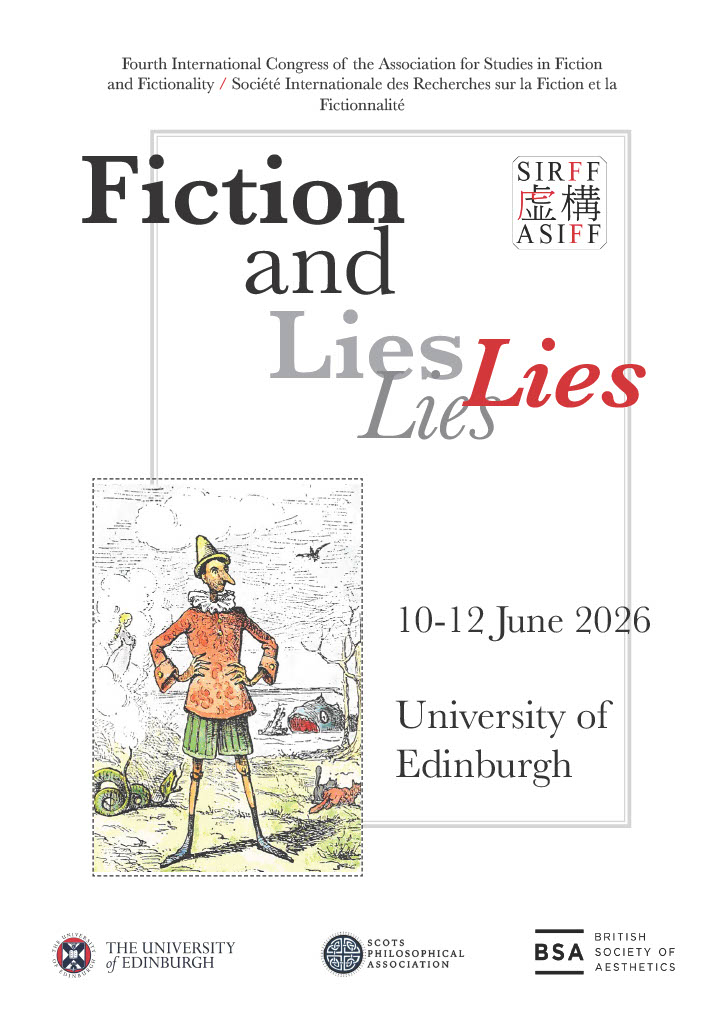
CALL FOR ABSTRACTS - ASIFF/SIRFF Fourth International Congress: Fiction and Lies - extended deadline

June 10-12 2026 University of Edinburgh, UK

By ADMIN SIRFF/ASIFF June 24th 2025


CALL FOR ABSTRACTS - ASIFF/SIRFF Fourth International Congress: Fiction and Lies

Send your submission before January 5th !

The Association for Studies in Fiction and Fictionality / Société Internationale des Recherches sur la Fiction et la Fictionnalité invites submissions on the theme of Fiction and Lies, for the ASIFF/SIRFF Fourth International Congress.


10-12 June 2026

University of Edinburgh, UK

Organization: Stacie Friend


Supported by the British Society of Aesthetics and the Scots Philosophical Association


Keynote Speakers

-Professor Eileen John (Philosophy, University of Warwick)

-Professor Pierre Bayard (Literature, Université Paris 8 - Saint-Denis)


From Plato’s indictment of the tragic poets as misrepresenting the truth, to Sir Philip Sidney’s famous claim in the Defence of Poesy that ‘the Poet, he nothing affirms, and therefore never lieth’, to current debates about fictionality and factuality, the relationship between fiction and lies has been a focus of scholarly attention. Both fiction-makers and liars make things up and misrepresent the truth. But it is traditionally assumed that with fiction, the invention is non-deceptive. As Margaret Macdonald (1954, 170) put the point, ‘The conviction induced by a story is the result of a mutual conspiracy, freely entered into, between author and audience. A storyteller does not lie, nor is a normal auditor deceived’. Macdonald proposed that instead, fiction-makers engage in a non-deceptive pretence of assertion (see also Searle 1975); but other approaches also distinguish between fictionality and deception, from philosophers who associate fiction with an invitation to make-believe rather than to believe (Walton 1990; Currie 1990; Lamarque and Olsen 1994; Davies 2012; García-Carpintero 2013; Lavocat 2016; Stock 2017) to narratologists who treat fictionality as a rhetorical mode of communication that overtly signals fabrication (Walsh 2007; Nielsen, Phelan, and Walsh 2015; Zetterberg Gjerlevsen 2019). If lies are assertions aimed at deception, perhaps fictions are incapable of lying (as some have argued, e.g., Mahon 2019; Stokke 2023; Marsili 2024; see Dixon 2022a; 2022b for a reply).

Yet a sharp distinction between fictionality and deception confronts numerous challenges. Scholars across disciplines have considered the many ways in which fictions can affect our beliefs, for good or ill (see James, Kubo, and Lavocat 2023). Even if fictions cannot lie in some technical sense, they can certainly mislead, insinuate, obfuscate and so on (for a detailed overview, see Fludernik and Packard 2021). Works of fiction may be instances of propaganda which misrepresent the facts; think of Oliver Stone’s film JFK (1991) or Michael Crichton’s novel State of Fear (2004). And the distinctions between the fictional and factual are under increasing pressure in the current culture of disinformation and ‘fake news’ – a category not so easy to distinguish from ‘fictional news’ (Pepp, Sterken, and Michaelson 2023).

This three-day international conference aims to explore the relationship between fiction and lies from a range of disciplinary and interdisciplinary perspectives, including philosophy, literary history and theory, narratology, film and media studies, psychology and cognitive science. Proposals may address fiction in general, or any historical period or cultural tradition. We also encourage studies of fictional works in a variety of media (including video games, comics, film, and television series).


Possible topics include but are not limited to:

·      The possibility of lying in/through fiction

·      Other modes of deception and dissimulation in fiction (in particular works, in different media, etc.)

·      Fiction and fictionality as (tools for) propaganda

·      The relationship between fiction and fake news

·      Differing historical or cultural conceptions of the relationship between fiction and lies

·      Representations of deception within fiction (e.g., unreliable narrators, lying protagonists, forgers)

·      Fictions that (seem to) deceive about their own status (e.g., mockumentary), and more generally, questions of ‘framing’


Please note: There may be a conference registration fee (discounted for students) depending on the outcome of grant funding applications.


Submission guidance

·      All submissions should be sent by attachment in Word or pdf to fictionlies2026@gmail.com by 5 January 2026.

·      Papers: Abstracts should be no longer than 350 words, in English or French. Bear in mind that sessions scheduled for paper presentations will be 30 minutes (20 minutes presentation, 10 minutes questions and answers).

·      Symposia: Proposals, in English or French, should be no longer than 500 words and should include a description of the topic/theme, the names/affiliations of participants and brief abstracts of the papers. Sessions for symposia will be 1.5 hours or 2 hours depending on the schedule and thus should typically have no more than three speakers.

·      We encourage submissions from, and symposia including, members of groups underrepresented in their disciplines, including women in philosophy. Symposia in philosophy should ensure that the proposal follows the Good Practice Policy of the British Philosophical Association and the Society for Women in Philosophy (see bpa.ac.uk/resources/women-in-philosophy/good-practice). Please also take note of the BPA’s Environment/Travel Guideline Scheme (bpa.ac.uk/policies).

·      Funding may be available towards the cost of arranging childcare for speakers who may require it. Please ask for details.

·      Participants in the conference will be expected to become members of the Association if they are not already (www.fictionstudies.org).


Early career prize

The ASIFF/SIRFF will offer a prize for the best paper by an early-career scholar (doctoral student or scholar who has received their PhD within the last 3 years), to be presented at the conference. The winner will receive a monetary award of €1,000 (euros). If you would like to be considered for this award, please submit your completed conference paper (no more than 3,500 words/20,000 characters) to fictionlies2026@gmail.com by 28 February 2026. The article must be unpublished.


References

Currie, Gregory. 1990. The Nature of Fiction. Cambridge: Cambridge University Press.

Davies, David. 2012. ‘Fictionality, Fictive Utterance, and the Assertive Author’. In Mimesis: Metaphysics, Cognition, Pragmatics, edited by Gregory Currie, Petr Kot’átko, and Martin Pokorný. College Publications.

Dixon, Daisy. 2022a. ‘Lies in Art’. Australasian Journal of Philosophy 100 (1): 25–39.

———. 2022b. ‘Novel Assertions: A Reply to Mahon’. The British Journal of Aesthetics 62 (1): 115–24.

Duprat, Anne, and Lavocat, Françoise, eds. 2010. Fiction et cultures. Nîmes: Lucie éditions.

Fludernik, Monika, and Stephan Packard, eds. 2021. Being Untruthful: Lying, Fiction, and the Non-Factual. Baden-Baden: Ergon Verlag.

García-Carpintero, Manuel. 2013. ‘Norms of Fiction-Making’. The British Journal of Aesthetics 53 (3): 339–57.

James, Alison, Akihiro Kubo, and Françoise Lavocat, eds. 2023. The Routledge Handbook of Fiction and Belief. New York: Routledge.

Lamarque, Peter, and Stein Haugom Olsen. 1994. Truth, Fiction, and Literature: A Philosophical Perspective. Oxford: Clarendon Press.

Lavocat, Françoise. 2016. Fait et Fiction. Pour une frontière. Paris : Le Seuil.

Macdonald, Margaret. 1954. ‘The Language of Fiction’. Proceedings of the Aristotelian Society, Supplementary Volumes 28:165–84.

Mahon, James Edwin. 2019. ‘Novels Never Lie’. British Journal of Aesthetics 59 (3): 323–38.

Marsili, Neri. 2024. ‘Fictions That Don’t Tell the Truth’. Philosophical Studies 181 (5): 1025–46.

Nielsen, Henrik Skov, James Phelan, and Richard Walsh. 2015. ‘Ten Theses about Fictionality’. Narrative 23 (1): 61–73.

Pepp, Jessica, Rachel Sterken, and Eliot Michaelson. 2023. ‘Fake News and Fictional News’. In The Routledge Handbook of Fiction and Belief. Routledge.

Searle, John R. 1975. ‘The Logical Status of Fictional Discourse’. New Literary History 6 (2): 319–32.

Stock, Kathleen. 2017. Only Imagine: Fiction, Interpretation and Imagination. Oxford: Oxford University Press.

Stokke, Andreas. 2023. ‘Fictional Force’. Philosophical Studies 180 (10): 3099–3120.

Walsh, Richard. 2007. The Rhetoric of Fictionality: Narrative Theory and the Idea of Fiction. 1st edition. Columbus: Ohio State University Press.

Walton, Kendall L. 1990. Mimesis as Make-Believe: On the Foundations of the Representational Arts. Cambridge, MA: Harvard University Press.

Zetterberg Gjerlevsen, Simona. 2019. ‘Fictionality’. In The Living Handbook of Narratology, edited by Peter Hühn et al. https://www-archiv.fdm.uni-hamburg.de/lhn/node/138.html.

Tutorial

how to write or modify an article on our website

By Anne BESSON October 18th 2024

Here's an article briefly explaining the main site's main features. 

1/ Login

In order to write an article or access the moderation functions (where applicable), you must log in (icon in the top right-hand corner of the site). 
Login :
 If you are already a member, your e-mail address is already known to us. Your login is Firstname.LASTNAME. Your password is automatically generated. You can change it by clicking on “password forgotten” and following the procedure.

If you are not yet a member, you will be asked to create an account (login and password) on the “Membership” page.and password). You will then be able to fill in and pay your membership fee. When you're “validated" by a moderator, you'll then be able to start write articles!

2/ Writing an article

To write a new article, simply click on the icon  "+" on the bottom right-hand corner of the home page. This will take you to the writing interface. Remember to give your article a title. By the style bar above the article, you can add a few simple effects or add an image/media file (pdf, audio file, Office documents): to do this, click on “Add media” in the style bar, then “upload”.
The side menu allows you to select one or more CATEGORIES for your articleas well as adding KEYWORDS if you wish.

3/ quick editing and shortcuts

To make your experience more pleasant and intuitive, all functionalities are accessible via icons  (usually a pencil ✎ for editing)

To edit an item, click on it or on the pencil and access the editing interface to make your own corrections.

4/ Languages

Changing the display language is a one-click operation, thanks to the language bar at the top right of the site. 3 languages are available FR-EN-JP.
Be sure to write your article in the selected language - translation is not automatic, you need to write in as many languages as you wish to display.


Join the ASIFF

By ADMIN SIRFF/ASIFF June 21st 2024

How to renew your membership or become a member of the ASIFF: 


For any questions, please contact 
Charlotte Krauss (Treasurer) or Anne Besson (General Secretary).

If you are already a member : all you have to do is pay your annual fee at the start of each calendar year - payment by bank transfer or credit card (Stripe): see below.

If you're not yet a member, you'll need to pay your membership fee and create an account so that we can access your personal informations and you can access the website's functionalities.  To “create an account”, enter your username in the format Firstname.LASTNAME, choose a password and fill out the online membership form

Membership dues :

  • 100 euros for a regular 3-year membership
  • 40 euros for 1-year membership, for those with a monthly income of more than 3000 euros
  • 20 euros/year for a monthly income between 2000 and 2999 euros
  • 15 euros/year for a monthly income between 1000 and 1999 euros
  • 10 euros/year for a monthly income under 1000 euros.

Payments may be made by bank transfer, or credit card (via Stripe). 

  • To pay by bank transfer (recommended method for payments coming from Europe or France)

Account Name: SOCIETE INTERNATIONALE DES REC
SIRFF/ASIFF 4 RUE DES IRLANDAIS, 75005 PARIS
International Account Number: FR76 1010 7006 3300 1170 6416 839
BIC Code: BREDFRPPXXX

  • Payment by credit card is available at the end of the form or directly below (Stripe platform with fees) :


About

By Anne BESSON March 15th 2024

Category : Members

Danielle PASCAL-CASAS

By ADMIN SIRFF/ASIFF May 28th 2024

Chercheuse indépendante (France) 

PhD Temple University, USA


Champs de Recherche : Langue, littérature, sciences humaines et sociales, anthropologie, non-fiction.

Affiliation : Membre de la SIRFF, Société Internationale de Recherches sur la Fiction et la Fictionnalité

Communications et Publications :

Pascal-casas, D. (1983).  El teatro social en la novelística de Juan Marsé. Ph.D .Thèse. Temple University (Philadelphie). University Microfilms International. 234 p.

Pascal-Casas, D. (1984, 13/01). Reevaluación de la muchacha de la bragas de oro de Juan Marsé. [Conférence] University of Pennsylvania (Philadelphie).

Pascal-Casas, D.  Lê Ngoc, D. Lacau, M ; Santomauro, A. 1987, ¡300 Millones !1ères. Nathan.

Pascal-Casas, D.  Lacau, M. 1986-1987, ¡300 Millones ! Vol.1-2. Vidéo Cassettes. Sélection d’émissions de la Télévision Espagnole. Nathan.

Pascal-Casas, D. 1988, « La función estructural del teatro en la novelística de Juan Marsé. » dans Anales de la literatura española contemporánea, n° 1-2, Vol 13 : 119-133.

Pascal-Casas, D. 1989, « París a la hora de España » dans  Hispania, n° 1, Vol. 72 : 179-191.

Pascal-Casas, D. (2023). L’Homo narrans et les variables de ses récits. Essai. Université de Montpellier. https://santesih.edu.umontpellier.fr/comptes-rendus-douvrages/

Pascal-Casas, D. (2024,16-17 mai). « Le décentrement des récits » [communication]. Colloque international : Fiction et Sciences sociales. Actes du colloque en voie de publication. Université Paul-Valéry Montpellier 3.

Pascal-Casas, D. (2024 ,25- 26 Octobre). « De l’autofiction genrée en tant que non-fiction, un paradoxe ? » [communication]. Colloque international : La littérarité de la non-fiction en question. Université ukrainienne de Tchernivtsi Yuri Fedkovych en partenariat avec le Centre de recherche sur les médiations- CREM de l’Université de Lorraine.

Pascal-Casas, D. « Gender Autofiction As ‘Non-Fiction’: A Paradox ? ». Pitannâ Lìteraturoznavstva, no. 111, June 2025, pp. 130-43, doi:10.31861/pytlit2025.111.130.

Pascal-Casas, D. (2024, 22- 23 Novembre). « Une étude de cas : Si l’enfant ne réagit pas d’Eric Chauvier » [communication]. Festival d’Anthropologie des mondes ordinaires. 8ème édition. Anthropologie-Fiction. Université de Bordeaux. Version éditoriale publiée sous l’intitulé : « L’écho des voix dans l’univers narratif de l’anthropologie dite ordinaire. Une étude de cas : Si l’enfant ne réagit pas d’Éric Chauvier »

https://antropologiabordeaux.wordpress.com/2025/03/12/lecho-des-voix-dans-lunivers-narratif-de-lanthropologie-dite-ordinaire/

Pascal-Casas, D. (2025, 18 Avril). Notes de lecture. Lettre ouverte à Bernard Traimond pour son livre Anthropologie de situations. L’influence de Jean-Paul Sartre. William Blake and Co. / Art § Arts Edit. 2023. 203 pages.

https://antropologiabordeaux.wordpress.com/2025/04/18/notes-de-lecture-bernard-traimond-anthropologie-de-situations-linfluence-de-jean-paul-sartre/

Pascal-Casas, D. (2025, 14 Novembre).« Des représentations artistiques de la matière humaine : une approche durassienne ? » [Communication]. Journée d'Etudes Annuelle Marguerite Duras "Marguerite Duras, descendances artistiques : dialogue avec les arts du XXIème siècle", Université de Lille, ALITHILA et Société Internationale Marguerite Duras.


Category : Members

Stacie FRIEND

University of Edinburgh

By ADMIN SIRFF/ASIFF May 29th 2024

Category : Events

Colloque: "Infofiction. Pacte factuel et flottements fictionnels dans la presse magazine" (Paris Nanterre, 11-12 décembre 2025).

Org. Matthieu Letourneux et Mélodie Simard-Houde

By Anne BESSON November 30th 2025

colloque info-fiction.jpg
Colloque: "Infofiction. Pacte factuel et flottements fictionnels dans la presse magazine" (Paris Nanterre, 11-12 décembre 2025). Université Paris Nanterre 

Bâtiment Ricoeur L, Salle LR15, rez-de-chausséeProgramme

Jeudi 11 décembre

8 h 45    Accueil

9 h 15    Mot d’introduction 

Séance 1 : Divertissement, vulgarisation et fictionnalisation

9 h 30    Yoan Vérilhac (Université de Nîmes), « Comment reconnaitre un magazine de divertissement quand on en voit un ? Encodage du genre et modes de lecture de l’information divertissante dans la presse magazine »

10 h 10  Aurélie Huz (Université Paris Nanterre), « Imaginaires du futur et discours de la science dans la presse de vulgarisation scientifique »

10 h 50  Pause 

Séance 2 : Fictionnel / factuel

11 h 10  Mélodie Simard-Houde (Université du Québec à Trois-Rivières), « L’infofiction à l’échelle du magazine sentimental : lecture réflexive et lecture esthétique »

11 h 50  Matthieu Letourneux (Université Paris Nanterre), « Fictionnel/factuel dans l’écosystème du kiosque à journaux et la série culturelle de ses imprimés »

12 h 30  Déjeuner 

Séance 3 : Presse de faits divers

14 h 00  Will Straw (Université McGill), « Midnight, Minuit, Globe : les circulations de l’infofiction montréalaise au-delà des frontières »

14 h 40  Harold Bérubé (Université de Sherbrooke), « “Histoires policières vraies” et “Drames étranges de la vie réelle” : la difficile mise en œuvre de l’infofiction dans Police Journal (1942-1954) »

15 h 20  Rachel Nadon (Université Laval), « Poétique de la “visibilité” : analyse croisée d’enjeux infofictionnels dans Allô Police, Le Journal des Vedettes et Échos Vedettes (1953-1969) »

16 h 00  Pause 

16 h 30  Entretien avec Lisa Delille, journaliste et écrivaine

 —

Vendredi 12 décembre

9 h 00    Accueil

Séance 4 : Dispositifs médiatiques et modes de lecture

9 h 30    Adrien Rannaud (Université de Toronto), « Les vedettes en série : stratégies textuelles et conditions matérielles de l’infofiction dans la presse de célébrités au Québec »

10 h 10  Marie-Pier Luneau (Université de Sherbrooke), « Autopsie de la matérialité info-fictionnelle : chirurgie à cœur ouvert de la presse de confession sentimentale au Québec »

10 h 50  Pause 

Séance 5 : Pratiques singulières et collectives de l’infofiction

11 h 10  Marie-Ève Thérenty (Université Montpellier 3), « L’affaire Lacaze ou “le sombre roman d’un jeune homme riche”. Fait divers et infofiction pendant les Trente Glorieuses »

11 h 50  Loïc Artiaga (Université de Pau et des Pays de l’Adour), « Malko reporter. Gérard de Villiers avant SAS (1950-1960)  

12 h 30  Déjeuner

14 h 00  Séance 6 : Présentations des stagiaires :

Samuel Charland, Sheila Gaudreau et Roxanne Larivée.

Category : Publications

Publication : Les Fables de l'homme. Pouvoirs des fabulations

David Simonin (dir.)

By Anne BESSON November 25th 2025

Capture d’écran 2025-11-21 à 10.42.14.png


Les Fables de l'homme. Pouvoirs des fabulations, Kimé, 2025.


Et si nos illusions façonnaient le réel plus sûrement que la vérité ? À l’ère des fake news, de la post-vérité et des réalités virtuelles, il ne fait plus de doute que les croyances fausses, les fictions et les illusions ont un impact profond sur nos sociétés. Ce qui fut longtemps perçu comme une déviation à corriger apparaît désormais comme une constante de la pensée et du comportement humains.
Cet ouvrage collectif propose une exploration inédite de cette puissance de la fabulation : pourquoi avons-nous besoin de nous raconter des histoires, individuellement et collectivement ? Quels sont les effets de ces récits et de ces représentations ? Croisant philosophie, littérature, sciences humaines et sociales, les auteurs interrogent les fondements de notre rapport à la réalité. Ce livre esquisse ainsi l’archéologie d’un régime de savoir aujourd’hui prégnant, dans lequel l’illusion, loin d’être toujours l’opposé de la vérité, en devient une force structurante avec laquelle il faut composer.


David Simonin, Introduction : les pouvoirs des fabulations

Première Partie

Fonctions de la Fiction

1. Françoise Lavocat, Femina Fabulatrix

2. Gerson Reuter, La compréhension de soi à travers les fictions

3. Valérie Stiénon, La dystopie comme fiction d’alerte : une approche du récit proactif

Deuxième Partie

Réécrire l’histoire

4. Johann Chapoutot, L’historien et le sens

5. Eva Schürmann, Qu’est-ce qui distingue l’historiographie de l’art du roman ?

Troisième Partie

Approches psychologiques de l’activité fabulatrice

6. Guido Baggio, Les contours de la cognition : Le vague et les croyances dans Les Principes de psychologie de William James

7. Lisa Bortolotti, Matteo Mameli et Kathleen Murphy-Hollies, Le Renard et le Hibou : confabulation, conspirations et régulation de soi

Quatrième Partie

Imaginaire social et fabulations juridico-politiques

8. Molly Andrews, Connaissance, croyance et incrédulité

9. Hans Kelsen, Le concept juridique et le concept sociologique de l’État. Examen critique du rapport entre l’État et le droit, § 33-35 (introduit et traduit par Christophe Bouriau)

10. Manuel Rebuschi, Le robot, personne ou personnage ?

Cinquième Partie

Récits et mises en scène de soi

11. David Simonin, Le bovarysme : manières de fabuler

12. Nathalie Luca, Filmer. Être filmé. Une mise en scène collaborative performative

13. Anna Caterina Dalmasso, Archéologie du selfie. Miroirs et autres fictions du soi

Journée d'études Atlas et fiction

Université de Poitiers, 24-25 septembre 2025

By Charlotte KRAUSS September 11th 2025

atlas251106.png

Atlas et fiction

Journée d’études

Université de Poitiers, FoReLLIS (UR 15076) – Espace Mendès France

Org. Charlotte Krauss (charlotte.krauss@univ-poitiers.fr)


Soirée grand public

Mercredi 24 septembre, 18-20h

Espace Mendès France

1 Pl. de la Cathédrale, 86000 Poitiers

Atlas : entre mondes connus et terres inventées


18h-19h45

Soirée grand public autour des atlas, des cartes et de la fiction

Jean-Marc Besse : L’atlas : espace graphique et pratiques cognitives

Charlotte Krauss : D’Utopia à Westeros : atlas de mondes imaginaires


Merci de vous inscrire ici (obligatoire, mais gratuit) : www.billetweb.fr/multi_event.php?multi=4357&color=217191&event_id=1291456


Jeudi 25 septembre

Journée d’études « Atlas et fiction »


MSHS de Poitiers, salle Mélusine

            5 Rue Théodore Lefebvre, 86000 Poitiers


9h30 Accueil (café)


9h45 ouverture


10h-10h45 – Mandana Covindassamy (ENS de Paris)

« Je n’ai rien inventé. Mais j’ai tout trouvé ». De la fiction dans l’Atlas des îles abandonnées de Judith Schalansky


10h45-11h30 – Jessy Neau (Univ. de Poitiers, FoReLLIS)

Se promener dans le Londres de Charles Dickens ou le Devon d’Agatha Christie : atlas et guides touristiques de l’Angleterre des écrivains


11h30-12h15 – Urs Urban (Bauhaus-Universität Weimar)

L’Atlas sentimental de la España vacía (2021) de Sergio del Molino : Topographies du vide dans l’imaginaire littéraire.


Pause (midi)


13h45-14h30Pierre Martin (Univ. de Poitiers, FoReLLIS)

L’imaginaire au seuil de l’Atlas (Renaissance et siècle classique)


14h30-15h15 – Myriam Marrache-Gouraud (Univ. de Poitiers, FoReLLIS / IUF)

Personnages et fiction réaliste dans les premiers atlas du XVIe siècle


Pause (café)


15h45-16h30 – Éric Puisais (UCO Niort)

La Carte de Tupaïa


16h30-17h15 Sophie Aymes (Univ. de Poitiers, FoReLLIS)

Jacquetta Hawkes : de la fiction géologique à l’atlas 


Résumé de la journée


Depuis l’apparition de Google Maps et d’autres applications GPS dans les années 2000, on aurait pu croire que le genre de l’atlas n’avait plus de raison d’être, l’information sur presque tous les lieux de la planète étant désormais disponible en quelques clics. Pourtant, l’atlas connaît aujourd’hui un regain d’intérêt : de nombreux éditeurs publient des atlas consacrés aux lieux les plus curieux, ou même à des entités détachées de la géographie, souvent sous la forme de beaux volumes destinés aux amateurs de cartes, aux armchair-travellers et aux bibliophiles.

Progressivement, l’atlas semble quitter le rayon « géographie » des librairies pour rejoindre celui de la « littérature ». L’exemple le plus célèbre de ce glissement est sans doute celui de l’écrivaine et artiste allemande Judith Schalansky avec son Atlas des îles abandonnées (2009), sous-titré dans sa version originale : Cinquante îles que je n’ai jamais visitées et que je ne visiterai certainement jamais. Ici, le but n’est plus tant l’information que le plaisir esthétique et narratif : belles cartes, anecdotes singulières, fragments d’histoires… de fiction, peut-être ? Dans son sillage, de nombreux ouvrages ont vu le jour : L’Atlas des contrées rêvées, L’Atlas des lieux maudits, L’Atlas des pays qui n’existent pas, etc. D’autres encore recensent les lieux littéraires ou les cartes présentes dans les arts, de L’Île au trésor de Stevenson au générique de Game of Thrones, comme The Writer’s Map de Huw Lewis-Jones ou L’Atlas des lieux littéraires de Cris F. Oliver.

Ce rapprochement entre atlas et fiction n’est pourtant pas nouveau. Depuis la naissance du genre, à la fin du XVI siècle, l’imaginaire a toujours été présent : on inventait des contrées encore inexplorées, on peuplait les marges des cartes d’êtres mythiques ou d’animaux fabuleux, comblant ainsi le vide des océans ou des zones blanches. Les monstres marins figurant sur la carte marine d’Olaus Magnus (XVI siècle) en sont l’exemple le plus fameux.

L’objectif de cette journée d’études est d’interroger ces liens entre atlas et fiction. Si une attention particulière sera portée aux productions contemporaines, l’histoire du genre et les périodes anciennes seront également considérées, dans une perspective interdisciplinaire : lettres, géographie, philosophie, histoire. Les réflexions porteront aussi bien sur la matérialité du livre que sur la relation texte-image. Alors que les cartes et la cartographie ont suscité de nombreux travaux récents, l’atlas en tant que forme spécifique a été moins étudié. Pourtant, par l’esthétique commune qu’il impose aux cartes qu’il rassemble, l’atlas suggère une cohérence et construit un monde à la frontière de la réalité et de la fiction.

Cette journée, à la croisée des études de genre littéraire, de l’intermédialité et des théories de la fiction, donnera lieu à une publication dans les Cahiers FoReLLIS. Organisée par le FoReLLIS (UR15076) en partenariat avec l’Espace Mendès France (Poitiers), dans le cadre d’un programme consacré à la cartographie, elle sera précédée d’une conférence ouverte au grand public la veille au soir.


Résumés des communications

& notices biobibliographiques


Sophie Aymes

Jacquetta Hawkes : de la fiction géologique à l’atlas 

Jacquetta Hawkes (1910-1996) est une archéologue et écrivaine anglaise qui reste aujourd’hui surtout connue pour son ouvrage A Land (1951). Ce texte scientifique et poétique offre une plongée dans le lointain passé de la formation géologique de l’archipel britannique et irlandais et retrace les mouvements migratoires qui l’ont peuplé. L’autrice livre un récit travaillé par l’imaginaire moderniste de la gestation des formes, illustré de dessins d’Henry Moore et de Ben Nicholson, ainsi que de photographies de Walter Bird. A Land narrativise l'histoire géologique des îles britanniques en tant que fiction, au sens étymologique du terme, un « façonnage » que prolonge l’activité poïétique humaine. Très impliquée dans la vulgarisation scientifique de l’archéologie, Jacquetta Hawkes contribua par la suite à des publications telles que History of Mankind (1963) pour l’UNESCO. Elle en vint à changer progressivement de format et fit paraître deux atlas dans les années 1970 (The Atlas of Ancient Archaeology de 1974 et The Atlas of Early Man de 1976). Ma communication retracera l’évolution intellectuelle de Jacquetta Hawkes, depuis le récit téléologique d’inspiration darwinienne de A Land à l’interprétation « diffusionniste » de l’histoire humaine proposée dans ses atlas. Pourquoi avoir choisi ce format ? Que devient sa « fiction géologique » à l’époque où la conquête spatiale impose de nouvelles formes de visualisation de la Terre ?


Sophie Aymes est professeure de littérature britannique à l’Université de Poitiers. Ses recherches portent sur l’intermédialité, le livre moderniste et l’illustration en Grande-Bretagne. Elle est co-fondatrice du réseau Illustr4tio spécialisé dans les études sur l’illustration, Secrétaire de l’association IAWIS et directrice de l’Equipe B de l’unité de recherche FoReLLIS. Sa monographie Modernist Mediascapes: Illustration, Print Culture, and the Matter of Books paraîtra prochainement chez Legenda.


Jean-Marc Besse

L’atlas : espace graphique et pratiques cognitives

Il s’agira, dans cet exposé, d’analyser l’atlas comme forme éditoriale et comme dispositif cognitif, à partir de quelques exemples d’atlas modernes et contemporains.


Jean-Marc Besse, philosophe et historien, est directeur de recherche émérite au CNRS et directeur d’études à l’EHESS. Ses recherches portent d’une part sur l’histoire des représentations et des pratiques de l’espace et la théorie du paysage, et d’autre part sur l’épistémologie des savoirs géographiques, à l’époque moderne et contemporaine. Il est co-directeur de la revue Les Carnets du paysage (Actes Sud-ENSP). Il dirige la collection « La nécessité du paysage » aux éditions Parenthèses (Marseille). Parmi ses livres : Les Grandeurs de la Terre. Aspects du savoir géographique à la Renaissance (2003) ; Face au monde. Atlas, jardins, géoramas (2003) ; Le goût du monde. Exercices de paysage (2009) ; Habiter. Un monde à mon image (2013) ; La nécessité du paysage (2018) ; Forme du savoir, forme de pouvoir. Les atlas géographiques à l’époque moderne et contemporaine (2022) ; Quelle est la raison des cartes ? (2023).


Mandana Covindassamy

« Je n’ai rien inventé. Mais j’ai tout trouvé. »

De la fiction dans l’Atlas des îles abandonnées de Judith Schalansky

L’Atlas des îles abandonnées de Judith Schalansky inaugure la collection des atlas poétiques publiée chez Arthaud. Mais en quoi réside la dimension poétique de cet ouvrage qui se consacre à des îles existantes et revendique n’avoir rien inventé ? La fiction peut-elle se loger ailleurs que dans l’écart par rapport à l’existant ? Il s’agira de voir quelle part revient à l’imagination dans le projet qui sous-tend cet atlas et comment la proposition de Schalansky remet en jeu la question de la mimesis dans le theatrum mundi de l’atlas.


Mandana Covindassamy est maîtresse de conférences en littérature de langue allemande à l’École normale supérieure - PSL (Ulm) et membre de l’UMR 8547 Pays Germaniques (CNRS/ENS-PSL). Ses recherches portent notamment sur les relations entre cartographie et littérature dans les œuvres de Goethe, W.G. Sebald, Alexander Kluge ou Judith Schalansky. Ses travaux portent également sur la mimesis, sur l’œuvre de Robert Walser ainsi que sur les relations entre la poésie persane et la littérature allemande.


Charlotte Krauss

D’Utopia à Westeros : atlas de mondes imaginaires

Les cartes de pays imaginaires existent depuis l’Antiquité, et certaines sont devenues emblématiques, comme celle d’Utopia ou, plus récemment, la carte de Westeros (Game of Thrones). Aujourd’hui, des atlas entiers sont consacrés à ces espaces : ils construisent des mondes composés, leur donnent une cohérence graphique et proposent de repenser la fiction par la cartographie.


Charlotte Krauss est professeure de littérature comparée à l’Université de Poitiers et directrice de l’unité de recherches FoReLLIS. Son projet en cours consacré aux atlas poétiques s’appuie sur deux de ses centres d’intérêt, les liens entre fiction et politique et les relations entre texte et image. Elle est l’auteur de La Russie et les Russes dans la fiction française du XIXe siècle. D’une image de l’autre à un univers imaginaire (2007) et de La Mise en scène de la nation. Les spectacles dans un fauteuil dans l’Europe post-napoléonienne (2022).


Myriam Marrache-Gouraud

Personnages et fiction réaliste dans les premiers atlas du XVIe siècle

L’idée de nommer « Atlas » les premiers livres de cartes nous rappelle que c’est par le nom d’un personnage que l’ouvrage qui porte le monde entier se distingue, par exemple, du planisphère ou du globe. Au moment de sa naissance au XVIe siècle, l’atlas inventorie toutes les terres et les mers du monde connu, mais aussi les êtres vivants. Cette enquête propose d’interroger la place réservée aux personnages dans de telles productions graphiques et discursives. Vérité ou fiction ? La présence de personnages dans les atlas, loin d’être strictement décorative ou fabuleuse, mérite d’être interrogée dans le texte comme sur l’image pour sa valeur vraisemblable. Insérer des personnages est un procédé qui construit sans doute une fiction réaliste à la portée de tous, mais ses enjeux sont peut-être plus politiques qu’anecdotiques pour le lectorat européen.


Myriam Marrache-Gouraud est professeure de littérature du XVIe siècle à l’Université de Poitiers. Elle est membre du laboratoire FoReLLIS (UR 15076) et membre senior de l’Institut Universitaire de France (IUF). Ses travaux portent sur Rabelais, l’écriture des savoirs et des mirabilia à la Renaissance. Attentive à la rencontre entre l’humanisme philologique et les énigmes du monde, elle s’intéresse à l’éloquence des objets singuliers et au rapport entre textes et images. Ses deux dernières monographies portent sur la poétique du catalogue (La légende des objets, Genève, Droz, 2020 ; L’homme-objet, Genève, Droz, 2022) et proposent de comprendre les musées à partir des textes qui en sont issus. À la croisée de la littérature, de l’histoire du livre et des sciences, son travail étudie les écrits de la curiosité, afin de comprendre leur rôle dans l’histoire épistémique des collections, et dans l’affirmation de ceux qu’on appelait curieux.


Pierre Martin

L’imaginaire au seuil de l’Atlas (Renaissance et siècle classique)

Le péritexte des Atlas de la période considérée est le lieu privilégié de l’expression, parfois directe, parfois oblique, d’un imaginaire collectif de l’entreprise géographique. On s’intéressera plus particulièrement à la façon dont les frontispices, ces configurations d’allégories empruntées à la Fable et autres motifs iconiques qui se font signes à déchiffrer, s’adressent aux « advisans » (équivalent Renaissance des modernes regardeurs) et acheteurs potentiels.


Pierre Martin, professeur retraité de l’Université de Poitiers, a consacré aux images de nombreux articles, dont « Des tatous et des hommes », dans H. Scepi et L. Louvel (éd.), Texte/image – Nouveaux problèmes, P.U. Rennes, colloque de Cerisy, 2005 ; « Un enfant dans le dos. Portrait de l’autre en abominable », dans S. Requemora-Gros et L. Guyon (dir.), Image et voyage, P.U. Provence, 2012 ; « Emblématique, bricolage et conscience sémiotique », revue Textimage, 2016 ; « Le squelette, la pelote et le mouchoir brodé : la collection de singularités anatomiques du Dr Ruysch, objet de méditation », dans F. Fix et L. Le Diagon-Jacquin (dir.), Le Paon d’Héra Mythologies du fil, 2024). Il a publié aussi trois éditions critiques : les Linguae vitia et remedia (1652) d’Antoine de Bourgogne sous le titre Les vices de la langue et leurs remèdes, Atlande, 2009 ; les Emblemes nouveaux (Francfort, 1617) d’Andreas Friedrich aux P. U. François-Rabelais, Tours, 2013 ; et chez le même éditeur, en 2020, sous le titre Un Monde de Curiosités, le manuscrit aquarellé d’Histoire naturelle d’Elie Richard (1700).


Jessy Neau 

Se promener dans le Londres de Charles Dickens ou le Devon d’Agatha Christie : atlas et guides touristiques de l’Angleterre des écrivains 

Le tourisme littéraire est un phénomène majeur au Royaume-Uni, caractérisé par des événements comme le festival Jane Austen, des visites de maisons-musées (Charles Dickens, Arthur Conan Doyle) et des pratiques interactives (reconstitutions de bals, murder parties, jeux de piste). Ces activités puisent dans un imaginaire intertextuel et mondialisé, rendant les lieux fictifs (Pemberley, 21B Baker Street) universels. Des ouvrages tels que A Dickens Atlas ou Agatha Christie's England valorisent le patrimoine cartographique et ré-enracinent ces imaginaires. Les itinéraires proposés, mélangeant lieux fictifs, biographiques et de tournage, renforcent les protocoles intertextuels et transfictionnels du tourisme littéraire, estompant les frontières entre fiction, adaptations et passé idéalisé. L'objectif de cette communication est de distinguer ces configurations au sein des pratiques de tourisme littéraire et fanique. Elle cherchera également à déterminer si ces objets sont une incarnation intermédiale des systèmes de représentations liés à la dichotomie structurelle de l'imaginaire britannique, explorée dans The Country and the City de Raymond Williams, essai fondateur des études culturelles.


Jessy Neau est maîtresse de conférences à l’Université de Poitiers et membre de l’unité de recherche FoReLLIS. Ses travaux de recherche se concentrent principalement sur les relations entre la littérature et les écrans, notamment le cinéma et les séries télévisées. Elle a publié Le cinéma de Wojciech Has au miroir de la littérature (2023) ainsi que Littérature et écrans : expansions de l’adaptation (2024) chez Peter Lang. 


Éric Puisais 

La Carte de Tupaïa

Considéré comme l’un des plus anciens artéfacts polynésiens conservés par les Européens, la carte de Tupaïa a longtemps été un mystère pour les géographes : illisible pour les occidentaux, on s’est parfois demandé si elle ne relevait pas de la fiction. Pourtant, elle représente un élément fondamental pour comprendre le « premier contact ». Tupaïa, prêtre-navigateur de Tahiti, originaire de Raiatea, a accompagné J. Cook lors de son premier voyage. Il a été le pilote du Dolphin dans la reconnaissance des îles polynésiennes. A la demande de Cook et de Banks, il a dessiné une carte. Nous chercherons à comprendre comment cette carte peut nous permettre aujourd’hui de repenser le « premier contact », en illustrant, par et avec la carte, l’incommensurabilité des appréhensions de l’espace.


Éric Puisais, docteur en philosophie et docteur en géographie, est maître de conférences en sciences politiques. Il est également directeur de programme au Collège International de Philosophie où sa recherche porte sur les liens entre la justice sociale et la justice spatiale.


Urs Urban

L’Atlas sentimental de la España vacía (2021) de Sergio del Molino : Topographies du vide dans l’imaginaire littéraire

L’Atlas sentimental de la España vacía (2021) est le troisième volet d’un projet livresque dans lequel le journaliste et écrivain Sergio del Molino se propose de cartographier la « psychogéographie de l’Espagne ». Ce qui l’intéresse avant tout, c’est ce qu’il appelle « l’Espagne vide », c’est-à-dire la grande majorité du pays au-delà des grandes métropoles (Madrid et Barcelone) et de la région côtière qui, sans jamais vraiment avoir été dépeuplée ou « décivilisée », a toujours été imaginée et mise en discours comme un espace vide dans lequel on a cru pouvoir situer toutes sortes de formes de vie « autres ». Ce sont ces espaces imaginés que l’on trouve dans son Atlas – tout comme dans des textes littéraires, en général fictifs, qui s’inscrivent, de leur côté, dans le discours sur « l’Espagne vide ».

Dans ma contribution, je me propose d’expliciter l’argumentation de del Molino et de rendre visible sa cartographie de l’Espagne vide en partant de son Atlas, avant d’identifier ses coordonnées dans la littérature narrative contemporaine et de montrer, à l’exemple du roman Intemperie de Jesús Carrasco (2013), comment celui-ci met en discours une « topographie du vide ».


Urs Urban est enseignant-chercheur en langues et littératures romanes. Après des stations à Strasbourg et Buenos Aires, il est actuellement maître de conférences HDR à la Maison des langues de l’Université Bauhaus à Weimar (Allemagne). Domaines de recherche principaux : Jean Genet, la théorie de l’espace, le storytelling et la conjoncture du récit épique, l’économie de la littérature, la représentation de la crise et la crise de la représentation (Argentine), le nouveau cinéma argentin. Il a récemment publié la monographie issue de son HDR soutenue en 2022 à l’Université Humboldt de Berlin : Conflit et médiation. L’économie du roman dans la Première Modernité (Espagne / France) (2024).


Category : Events

Seminar on the Question of Fictionality

University of Helsinki, Octobre 20 2025

By Kai MIKKONEN September 23rd 2025

art251106.png

Seminar on the Question of Fictionality


Monday 20.10.2025 12-16.


Place: University of Helsinki main building, Lecture hall U3039.

Address: Fabianinkatu 33. Please see:

https://tilavaraus.helsinki.fi/en/city-centre/main-building-fabianinkatu-33/main-building-u3039


There is no registration for the seminar. The event is open to all participants in the Method and Matter research network at the U of Helsinki and those interested. Welcome!


12:00-12:10

Welcome and introduction: Prof. Kai Mikkonen (U of Helsinki)


12:15-13:00

Keynote Prof. Nicholas D. Paige (keynote, UC Berkeley): “What Should a Long History of Fiction Look Like?” 35+10min for discussion


Coffee break 13:00-13:15


13:15-14:15

Prof. Alison James (U of Chicago): “Hybridity without Blurring: Configuring Fictionality in Contemporary Literature.” 20+10min

Prof. Françoise Lavocat (U Sorbonne Nouvelle–Paris 3): “Fictionality: Variants and Inviariants.” 20+10min


14:15-15:15

postdoc researcher Simona Bartolotta (Justus-Liebig U of Giessen): “Regimes of Interpretation: Fictionality in the Art of Fiction.” 20+10min

postdoc researcher Juulia Jaulimo (U of Helsinki): “The Composition Must Be True": On the Limits and Ethics of Fictional Truth in Agota Kristóf’s Notebook Trilogy.” 20+10min


15:15-16:00

Ass. Prof. Alexander Yudin (Taras Shevchenko National U of Kyiv): “The Text as a Deed: Act-performing Writing in Andrei Bitov's Prose.” (online) 20min

Response: postdoc researcher Daria Kondakova (U of Helsinki). 10min

The presentations will be followed by a doctoral students’ workshop. The discussion on doctoral students’ papers (Esko Roininen, Ansa Salonen) is for the participants of the research seminar in literary studies. (16:15-18).


Invited speakers:

Nicholas D. Paige is the author of Technologies of the Novel: Quantitative Data and the Evolution of Literary Systems (Cambridge UP, 2021), the first quantitative history of the novel based on a systematic sampling of French- and English-language works from 1600 to 1830. His earlier book, Before Fiction: The Ancien Régime of the Novel (U Penn Press, 2011), examines the novel through the lens of fictionality, understood primarily as the principle that literary characters need not correspond to real people to remain credible and compelling. More information is available on his homepage: link


Alison James, Professor of French at the University of Chicago, is the author of Constraining Chance: Georges Perec and the Oulipo (Northwestern UP, 2009) and The Documentary Imagination in Twentieth-Century French Literature (Oxford UP, 2020). She has also co-edited volumes on fiction and belief, the everyday, hybrid genres, and chance in literature. Together with Françoise Lavocat and Akihiro Kubo, she co-founded the Association for Studies in Fiction and Fictionality (ASIFF).


Françoise Lavocat, Professor of French and Comparative Literature at the Université Sorbonne Nouvelle–Paris 3, specializes in theories of fiction (fact and fiction, possible worlds, characters), early modern literature, and narratives of catastrophe. Her publications include Arcadies malheureuses: aux origines du roman moderne (Champion, 1997), La Syrinx au bûcher: Pan et les satyres à la Renaissance et à l’âge baroque (Droz, 2005), Usages et théories de la fiction: la théorie contemporaine à l’épreuve des textes anciens (Presses Universitaires de Rennes, 2004), La théorie littéraire des mondes possibles (CNRS, 2010), and Fait et fiction: pour une frontière (Seuil, 2016). Interview link


Alexander Yudin is Professor in the Department of World Literature and Theory of Literature at Dragomanov Ukrainian State University and Associate Professor in the Department of Foreign Languages at Kyiv National Taras Shevchenko State University. His research spans philosophy and theory of literature, interpretation, authorial intention, the history of authorship, and M.M. Bakhtin’s aesthetics. He has published two monographs: Text as a Deed and a Way: Poetics of the Performative in Andrei Bitov’s Book of Travels (2008) and Authorship as a Cultural Institution (2016).


Simona Bartolotta is a Humboldt Postdoctoral Fellow on the project Towards a Theory of Post-Anthropocentric Narrative at the Department of English/Institut für Anglistik, Justus-Liebig Universität Gießen. Profile link


Juulia Jaulimo, Postdoctoral Fellow at the University of Helsinki, defended her doctoral dissertation What is Impossible for Fiction? in May 2025.


Daria Kondakova is a Postdoctoral Fellow at the University of Helsinki, currently researching cultural connections between Kyiv and Helsinki (1880–1920) from a post-imperial perspective. Profile link


Category : Events

Theorizing the Nonfiction Distinction

Proposed Seminar, ACLA 2026

By Alison JAMES August 26th 2025

Category : News / Events

Fiction et fictionnalité auctoriales dans les littératures d’Asie

Appel à communications pour un colloque à l'Université Sorbonne nouvelle, Paris, 26-27 mars 2026

By Maëlle SAVINA July 18th 2025

header

2009, « Ethos discursif et image d’auteur » [En ligne], mis en ligne le 15 octobre 2009, consulté le 29 octobre 2024, [en ligne] https://doi.org/10.4000/aad.656.

Détrie Muriel et Jeong Eun-Jin (éd.), L'enseignement des littératures asiatiques et la traduction : expériences, interrogations et propositions, Librairie You Feng, 2022.  

Diaz Brigitte (éd.), L’auteur et ses stratégies publicitaires au XIXe siècle, Presses universitaires de Caen, 2019, [en ligne] https://doi.org/10.4000/books.puc.17431.

Dubel Sandrine et Rabau Sophie (éd.), Fiction d’auteur ? Le discours biographique sur l’auteur de l’antiquité à nos jours, Champion, 2001.

Duprat Anne et Lavocat Françoise (éd.), Fiction et cultures. Théories de la fiction, coll. Poétiques comparatistes, Société française de littérature générale et comparée, Paris, 2010.

Veck Bernard et Verrier Jean (éd.), La littérature des autres : place des littératures étrangères dans l'enseignement des littératures nationales, actes des journées d'étude tenues à l'Institut national de recherche pédagogique, Paris, 1-3 juin 1994, INRP, 1995.

Amossy Ruth, « La double nature de l’image d’auteur », Argumentation et analyse du discours, n° 3, 2009, [en ligne] https://doi.org/10.4000/aad.662.  

Barthes Roland, « La Mort de l’auteur », Mantéia, n° 5, 1968.

________, Le plaisir du texte, Seuils, 1973.

Bokobza Kahan Michèle, « Métalepse et image de soi de l’auteur dans le récit de fiction »,  Argumentation et analyse du discours, 3, 2009, [en ligne] https://doi.org/10.4000/aad.671.  

Brunn Alain, L’auteur, coll. « Corpus », Flammarion, Paris, 2001.

Couturier Maurice, La Figure de l’Auteur, Le Seuil, Paris, 1995.

Chevillard Jean-Luc, « On four types of poets and four types of scholars : from pulavar to kavi in the changing intellectual landscape of Tamil Nadu », Histoire Épistémologie Langage, tome 36, fascicule 2, 2014. Hommage à Djamel Eddine Kouloughli. pp. 149-166, [en ligne]  https://doi.org/10.3406/hel.2014.3504.

Diaz José-Luis, L’Écrivain imaginaire. Scénographies auctoriales à l’époque romantique, Champion, Paris, 2007.

Ebbesen Jeffrey, « The Question of Authorship in Indian Literature », Literary India : Comparative Studies in Aesthetics, Colonialism, and Culture, Patrick Colm Hogan, Lalita Pandit (éd.), State University of New York Press, 1995.

Étiemble Renée, Essais de littérature (vraiment) générale, Gallimard, Paris, 1974.

Gan Lu, « À la recherche de la force de l’infériorité », Impressions d’Extrême-Orient, 12, 2021, mis en ligne le 30 juin 2021, consulté le  12 avril 2025, [en ligne] https://doi.org/10.4000/ideo.1639.

Garcin Thomas, « Un Mishima pluriel et inédit », Nonfiction, 2020 [en ligne] https://www.nonfiction.fr/article-10297-un-mishima-pluriel-et-inedit.htm.

Genette Gérard, Seuils, Le Seuil, Paris, 1987.

________, Fiction et diction, Le Seuil, Paris, 1994.

Hariharan Vidhya, « Avvaiyar : The relevance of the ancient tamil poet to contemporary indian society », in Gap Bodhi Taru a global journal of humanities, Volume - VII Issue II April – June 2024, [en ligne] https://www.gapbodhitaru.org/view-articles.php?iid=39 doi.org/10.47968/5857.

Han Jingjing « Fausse biographie, authentique fable : la Biographie de Mao Ying », Impressions d’Extrême-Orient 16

Category : News

AAC/ CFP : Star Trek, dynamiques d’une fabrique de mondes : expansion, variation, densification

Appel à communications ouvert jusqu'au 15 janvier 2026

By Jessy NEAU September 9th 2025

header

AAC/ CFP : Star Trek, dynamiques d’une fabrique de mondes : expansion, variation, densification / Star Trek, Dynamics of a World-Building Factory : Expansion, Variation, Densification (Paris)

https://startrekparis2026.wordpress.com/


[English version will follow.]


Depuis les soixante ans qui nous sépareront bientôt de sa première diffusion le 8 septembre 1966, Star Trek s’est imposé comme un univers de fiction proliférant, transmédiatique et intergénérationnel que l’on peut diviser en trois grandes ères. La première est celle des débuts hésitants de la première série télévisée, dénommée désormais Star Trek: The Original Series (1966-1969) et de sa continuation animée (1973-1974). La deuxième, amorcée dès 1979 par la sortie au grand écran de Star Trek: The Motion Picture, s’est poursuivi au cinéma (9 films entre 1982 et 2002) et dans de nombreuses séries télévisées dérivées : The Next Generation (1987-1994), Deep Space Nine (1993-1999), Voyager (1995-2001) et Enterprise (2001-2005). La troisième ère, encore en cours, débute également au cinéma en 2009 par un reboot de la franchise au gré d’une trilogie lancée par J.J. Abrams qui s’est conclue en 2016. Depuis, c’est la continuité initiale du monde fictionnel qui est développée par des préquelles et suites télévisuelles sur les plateformes de vidéos à la demande (SVoD) : Discovery (2017-2024), Picard  (2020-2023), Strange New World (2022-), sans compter les séries d’animation et un téléfilm. À ces œuvres audiovisuelles, il faut ajouter de nombreux romans, bandes dessinées, fanfictions et jeux vidéo.

Au fil des années et à travers les médias, l’ambition de la franchise est restée la même : décrire un futur relativement proche (XXIIe à XXVe siècles, avec une incursion plus récente au XXXIIe siècle), imaginé par son créateur, Gene Roddenberry, comme une utopie, quoiqu’elle a pu proposer à l’occasion des moments plus sombres ou pessimistes. Dans Star Trek, l’humanité a su surmonter les obstacles politiques, écologiques et moraux du XXIe siècle pour atteindre les étoiles et participer à la création de la Fédération des Planètes Unies, rassemblant de nombreuses civilisations extraterrestres à travers la galaxie, séparée en quatre immenses quadrants. 

Évidemment, si cette série de science-fiction utopique est née dans les années 1960, ce n’est sans doute pas un hasard. La première version, qui apparaît alors que la course à l’espace et la révolution sexuelle éveillent les imaginations, peut également être vue comme un reflet critique des tensions de la guerre froide et des débats de société états-uniens dans les années 1960, notamment les luttes pour les droits civiques. Il faut dire que la présence d’acteurs russe et japonais et d’une actrice afro-américaine pour interpréter certains des officiers sur le pont du USS Enterprise n’est pas passée inaperçue, tout comme le premier baiser à transcender les tabous raciaux de la télévision américaine de l'époque. Mais le relatif progressisme (plusieurs ont pointé ses limites depuis) de Star Trek n’était pas que dans la production, il alimentait également les scénarios qui proposaient chaque semaine une nouvelle planète et ses habitants, une planète qui élargissait le monde fictionnel toujours en expansion et qui permettait d’aborder différents enjeux politiques ou culturels par analogie. On note ainsi que l’expansion est une dynamique structurante de la franchise dès ses origines. Cette volonté se prolonge d’ailleurs aujourd’hui : chaque époque a sa version de Star Trek qui aborde ses problèmes spécifiques ou plus universels. The Next Generation apparaît alors que Ronald Reagan est au pouvoir et déconstruit certains des acquis des luttes sociales des années 1960; Voyager propose un personnage de femme capitaine forte, mais conservatrice et parfois assez autoritaire, alors que le féminisme subit des contrecoups; Discovery s’intéresse aux enjeux de la diversité sexuelle (orientation sexuelle et genre); Picard aborde la question des réfugiés environnementaux et l’intelligence artificielle, etc.

Ce n’est donc pas surprenant si, depuis les années 1990, Star Trek est devenu un objet d’étude privilégié dans les cultural studies anglo-saxonnes, dans les études sur les médias populaires et sur la science-fiction, mais ces études demeurent très rares du côté francophone. La plupart des travaux sont centrés sur ses dimensions idéologiques, politiques et sociales. Mentionnons l’apparition très tôt d’analyses des représentations raciales (Bernardi 1998, Kilgore 2003, Mittermeier and Spychala 2020), de lectures sociopolitiques plus larges (Reagin 2013, Booker 2018), de travaux sur le genre (Farghali et Bacon 2017, Mittermeier and Spychala 2020, Millsap-Spears 2024) ou sur la diplomatie galactique (Gonzalez 2015). 

Pourtant, si l’univers Star Trek a suscité une quantité impressionnante d’analyses critiques, peu de travaux prennent pour objet principal la construction de son monde fictionnel en tant que telle — sa logique interne, sa narrativité transmédiatique, sa plasticité ontologique. L’exception notable est le champ des fan studies qui examine comment les communautés de fans participent à l’expansion, la critique ou la réécriture du canon (Jenkins 1992, Falzone 2005, Drushel 2013), mais sans toujours en articuler les implications esthétiques ou narratives. Pourtant, dès ses débuts, Star Trek est envisagé par certains, comme Michael Moorcock (1968), comme un véritable tournant pour la fiction et la narration, inaugurant une exigence nouvelle de diversité narrative, d’engagement social avec les spectateurs et de franchissement des frontières de genre, intégrant une interpénétration des textes savants avec des formes populaires.

Il semble donc aujourd’hui nécessaire d’interroger Star Trek sous l’angle de ses pratiques narratives, esthétiques et mythopoétiques (Kapell 2010), en recentrant l’attention sur les modalités de sa construction fictionnelle. Loin de rejeter les approches politiques et culturelles qui ont dominé la recherche sur Star Trek, ce colloque entend les prolonger dans une autre direction, en interrogeant ce que signifie « fabriquer des mondes » dans et autour de Star Trek. Le présent colloque, qui célèbre les 60 ans de la franchise, souhaite ainsi déplacer le regard vers le worldbuilding de Star Trek, entendu non comme un arrière-plan figé, mais comme un processus dynamique, un système en expansion, parfois en contradiction, toujours en transformation. Cet univers, qui articule continuités et ruptures à travers ses nombreuses itérations, offre un terrain privilégié pour penser la création d’univers cohérents dans leur plasticité même, ainsi que les tensions entre continuité, divergence et reprise; utopie, dystopie et uchronie; récit, imaginaire et encyclopédisme.

Par ailleurs, la dimension encyclopédique de l’univers de Star Trek est parfois si patente qu’elle a alimenté la publication d’ouvrages qui traitent son matériau fictionnel – envisagé comme un « bien expressif » (Kavanagh et al 2001) –  comme le feraient de véritables encyclopédies (Ruditis 2013). Et c’est sans compter le megatext science fictionnel (Broderick 1995) et la xénoencyclopédie (Saint-Gelais 1999) qu’il a largement contribué à construire et à alimenter : vaisseaux spatiaux, téléporteurs, communicateurs et scanners, traducteurs universels, androïdes, fédération de planètes, directive première et protocole de premier contact, etc. Les exemples de novums qui ont construit le monde fictionnel de Star Trek avant de devenir des éléments incontournables de tout space opera abondent.

Dans le cadre de ce colloque, nous vous invitons à réfléchir à la fabrique de l’univers de Star Trek, bien plus vaste qu’un simple monde possible, selon une pluralité d’approches : narratologique, esthétique, sémiotique, intertextuelle, médiologique ou anthropologique. Il pourra notamment s’agir de questionner :

  • les modalités du récit dans Star Trek : formes sérielles, transmédiatiques, épisodes expérimentaux, dispositifs d’embrayage ou de reconfiguration du monde diégétique;
  • les tensions entre cohérence et contradiction dans l’univers étendu (continuité, retcon, paradoxes temporels, mondes parallèles);
  • les dimensions esthétiques des mondes Star Trek : architecture, design, modes de corporéité, rapports aux technologies;
    l’invention de langues comme le klingon (Lecercle 2015) comme poétique de l’altérité ou le traducteur universel comme politique de l’universalisme;
  • l’exploration spatiale, le voyage temporel et le monde virtuel (holodeck/holosuite) comme modes d’expansion fictionnelle;
    l’utilisation des mécanismes de l’Histoire humaine et de la mythologie dans la création par analogie de mondes, de peuples et de planètes;
  • les réemplois, détournements intertextuels (science-fiction « classique », tragédie shakespearienne, figures du roman policier ou du roman maritime, mais aussi productions dérivées, pastiches [The OrvilleGalaxy QuestDans une galaxie près de chez vous, etc.], hommages, parodies ou fanfictions); 
  • les interactions entre texte officiel et productions faniques (fanlore, slash fiction, encyclopédies communautaires) comme autant de reconfigurations du monde partagé.

Ce colloque propose donc de rejoindre les débats actuels sur la narratologie transmédiale (Baroni 2017) et sérielle (Letourneux 2017, Favard 2018, Machinal 2020), sur la fiction spéculative (Forêt et Yulmuk-Bray 2024, Stengers 2020 et 2000), la poétique du mythe et la construction contemporaine des mondes imaginaires (Kapell 2010, Besson 2015). Il s’agit ainsi de penser Star Trek non seulement comme un miroir critique du monde, mais aussi comme une machine fictionnelle et narrative, autoréflexive, en expansion constante, qui pose des questions fondamentales sur la narration (du point de vue de sa création comme de sa réception), la cohérence, la norme et l’altérité.

Le colloque aura lieu du jeudi 17 au samedi 19 septembre 2026 au Collège britannique à la Cité internationale à Paris. Les propositions de communication (25 min) d’un maximum de 350 mots, accompagnées d’une courte notice bio-bibliographique, sont à envoyer avant le 15 janvier 2026 à l’adresse suivante : startrekparis2026@gmail.com. Les communications pourront être en français ou en anglais. 

Comité d’organisation : Elaine Després (Université du Québec à Montréal), Florent Favard (Université de Lorraine, CREM), Anaïs Guilet (Université Savoie Mont Blanc, Laboratoire LLSETI), Hélène Machinal (Université Rennes 2, ACE) et Jessy Neau (Université de Poitiers, FoReLLIS).

Bibliographie

  • Baroni, Raphaël. (2017). « Pour une narratologie transmédiale ». Poétique, no 182 (2), pp. 155-175.
  • Bernardi, Daniel. (1998). Star Trek and History: Race-Ing toward a White Future. New Brunswick : Rutgers UP.
  • Besson, Anne (2015). Constellations. Des mondes fictionnels dans l’imaginaire contemporain. Paris : CNRS edition.
  • Booker, M. Keith (2018). Star Trek: A Cultural History. New York : Rowman & Littlefield.
  • Broderick, Damien (1995). Reading by Starlight: Postmodern Science Fiction. New York : Routledge.
  • Després, Elaine (2020). « La sentience des androïdes : de Star Trek à Westworld ». Dans J.-F. Chassay et I. Boof-Vermesse (dir.), L’âge des postmachines, Montréal : PUM, pp. 73-92.
  • Després, Elaine (2019), « Voyage (impromptu et déroutant) au bout de l’univers », Otrante, art et littérature fantastique, no 46, automne, pp. 13-33.
  • Drushel, Bruce E. (dir.) (2013). Fan Phenomena: Star Trek. Bristol : Intellect Books.
  • Falzone,  Paul J. (2005). « The Final Frontier Is Queer: Aberrancy, Archetype and Audience Generated Folklore in K/S Slashfiction ». Western Folklore, été-automne, vol. 64, no 3/4, pp. 243-261. https://www.jstor.org/stable/25474751.
  • Farghali, Nadine et Bacon, Simon (2017). To Boldly Go. Essays on Gender and Identity in the Star Trek Universe. Jefferson : McFarland.
  • Favard, Florent (2018). Le récit dans les séries de science-fiction. De Star Trek à X-Files. Paris : Armand Colin.
  • Favard, Florent et Hélène Machinal (dir.) (2019). « La sérialité en question ». TV/series, no 13.
  • Favard, Florent et Hélène Machinal (dir.) (2022). « Séries télévisées de science-fiction ». Res Futurae, no 19.
  • Forêt, Marceau et Yulmuk-Bray, Ketzali (2024). « Nouvelle alliance entre science et fiction ». Revue critique de fixxion française contemporaine, no 28. https://doi.org/10.4000/11u01
  • Gonzalez, Georges A. (2015). The Politics of Star Trek. Justice, War, and the Future. New York : Palgrave MacMillan.
  • Jenkins, Henry (2006). Convergence Culture: Where Old and New Media Collide. New York : New York University Press.
  • Jenkins, Henry (1992). Textual Poachers: Television Fans and Participatory Culture. New York : Routledge.
  • Kapell, Matthew Wilhelm (dir.) (2010). Star Trek as Myth: Essays on Symbol and Archetype at the Final Frontier. Jefferson : McFarland.
  • Kilgore, De Witt Douglas (2003). Astrofuturism: Science, Race, and Visions of Utopia in Space. Philadelphie : University of Pennsylvania Press.
  • Lecercle, Jean-Jacques (2015). « Bleghbe’chugh vaj blHegh! From an Ethics of Alterity to a Politics of Style ». Dans M. Rospide et S. Sorlin (dir.), The Ethics of Alterity : New perspectives on Genre Literature, Cambridge Publishers, pp. 14-32.
  • Letourneux, Matthieu (2017). Fictions à la chaîne. Paris : Seuil, coll. « Poétique ».
  • Machinal, Hélène (2020). Posthumains en série. Tours : Presses universitaires François-Rabelais.
  • Millsap-Spears, Carey (2024). Star Trek Discovery and the Female Gothic. Lanham : Lexington Books.
  • Mittell, Jason (2015). Complex TV: The Poetics of Contemporary Television Storytelling. New York: NYU Press.
  • Mittermeier, Sabrina et Garcia-Siino, Leimar (dir.) (2022). The Routledge Handbook of Star Trek. New York : Routledge.
  • Mittermeier, Sabrina et Spychala, Mareile (dir.) (2020). Fighting for the Future – Essays on Star Trek: Discovery. Liverpool : Liverpool University Press.
  • Neau, Jessy (2024). « Star Trek : The Next Generation (1987-1994) ; un procès caché de l’humanité en sept saisons », TV/Series, no 23. https://doi.org/10.4000/12lhs
  • Reagin, Nancy (2013). Star Trek and History. Hoboken : Wiley.
  • Ruditis, Paul (2013). Star Trek: The Visual Dictionary: The Ultimate Guide to Characters, Aliens, and Technology. Londres : DK.
  • Saint-Gelais, Richard (1999). L’empire du pseudo. Modernités de la science-fiction. Québec : Nota Bene.
  • Stengers, Isabelle (2020). « Ursula Le Guin-Penser en mode SF ». Épistémocritique, hors série, https://epistemocritique.org/ursula-le-guin-penser-en-mode-sf/ 
  • Stengers, Isabelle (2000). « Science-fiction et expérimentation ». Dans Philosophie et science-fiction, Bruxelles: Vrin. 

 ********************************************

Star Trek, Dynamics of a World-Building Factory : Expansion, Variation, Densification
Call for papers - International conference

Since its first broadcast on September 8, 1966, Star Trek has established itself as a prolific, transmedia, and intergenerational fictional universe that can be divided into three major eras. The first is that of the tentative beginnings of the first television series, now known as Star Trek: The Original Series (1966-1969), and its animated continuation (1973-1974). The second era began in 1979 with the release of Star Trek: The Motion Picture and continued with nine films between 1982 and 2002, as well as numerous spin-off television series: The Next Generation (1987-1994), Deep Space Nine (1993-1999), Voyager (1995-2001) and Enterprise (2001-2005). The third era, which is still ongoing, also began in the cinema in 2009 with a reboot of the franchise in the form of a trilogy launched by J.J. Abrams, which concluded in 2016. Since then, the initial continuity of the fictional world has been developed through prequels and sequels on video-on-demand (SVoD) platforms: Discovery (2017-2024), Picard (2020-2023), Strange New World (2022-), not to mention animated series and a TV movie. In addition to these audiovisual works, there are numerous novels, comic books, fan fiction, and video games.

Over the years and across media platforms, the franchise's ambition has remained the same: to depict a relatively near future (from the 22nd to 25th centuries, with a more recent foray into the 32nd century), imagined by its creator, Gene Roddenberry, as a utopia, even though it has occasionally offered darker or more pessimistic moments. In Star Trek, humanity has overcome the political, ecological, and moral obstacles of the 21st century to reach for the stars and participate in the creation of the United Federation of Planets, bringing together numerous alien civilizations across the galaxy, divided into four immense quadrants.

Of course, it is probably no coincidence that this utopian science fiction series was created in the 1960s. The first version, which appeared at a time when the space race and the sexual revolution were capturing people's imaginations, can also be seen as a critical reflection of the tensions of the Cold War and the social debates in the United States in the 1960s, particularly the civil rights movements. Obviously, the presence of Russian, Japanese, and African-American actors playing some of the officers on the bridge of the USS Enterprise did not go unnoticed, nor did the first interracial kiss on American television. But Star Trek's relative progressiveness (it has since been nuanced by many) was not limited to the production; it also fueled the scripts, which each week presented a new planet and its inhabitants, a planet that expanded the ever-growing fictional world and allowed different political and cultural issues to be addressed by analogy. It is clear that expansion has been a defining dynamic of the franchise since its inception. This desire continues today: each era has its own version of Star Trek that addresses its specific or more universal problems. The Next Generation appeared while Ronald Reagan was in power and dismantled some of the gains made by the social struggles of the 1960s. Voyager introduced a strong female captain, yet she was also quite conservative and sometimes even authoritarian, but the context was that of a feminist backlash. Discovery focuses on issues of sexual diversity (sexual orientation and gender); Picard addresses the issue of environmental refugees and artificial intelligence, etc.

It is therefore not surprising that, since the 1990s, Star Trek has become a favored subject of study in Anglo-Saxon cultural studies, popular media studies, and science fiction studies, but such studies remain very rare in the French-speaking world. Most of the work focuses on its ideological, political, and social dimensions. Noteworthy are the early analyses of racial representations (Bernardi 1998, Kilgore 2003, Mittermeier and Spychala 2020), broader sociopolitical readings (Reagin 2013, Booker 2018), works on gender (Farghali and Bacon 2017, Mittermeier and Spychala 2020, Millsap-Spears 2024) and galactic diplomacy (Gonzalez 2015).

However, while the Star Trek universe has been the subject of an impressive amount of critical analysis, few works focus primarily on the construction of its fictional world as such—its internal logic, transmedia narrativity, and ontological plasticity. The notable exception is the field of fan studies, which examines how fan communities participate in the expansion, critique, or rewriting of the canon (Jenkins 1992, Falzone 2005, Drushel 2013), but without always articulating the aesthetic or narrative implications. Yet, from its inception, Star Trek has been viewed by some, such as Michael Moorcock (1968), as a true turning point for fiction and storytelling, ushering in a new demand for narrative diversity, social engagement with viewers, and the crossing of genre boundaries, integrating an interpenetration of scholarly texts with popular forms.

It therefore seems necessary today to examine Star Trek from the perspective of its narrative, aesthetic, and mythopoetic practices (Kapell 2010), refocusing attention on the modalities of its fictional construction. Far from rejecting the political and cultural approaches that have dominated research on Star Trek, this conference aims to extend them in another direction, by questioning what it means to “make worlds” in, around or from Star Trek. This conference, which celebrates the franchise's 60th anniversary, thus seeks to shift the focus to the worldbuilding of Star Trek, understood not as a fixed backdrop, but as a dynamic process, an expanding system, sometimes contradictory, always in transformation. This universe, which articulates continuities and ruptures through its many iterations, offers a privileged terrain for thinking about the creation of universes that are coherent in their very plasticity, as well as the tensions between continuity, divergence, and revival; utopia, dystopia, and uchronia; narrative, imagination, and encyclopedism.

Furthermore, the encyclopedic dimension of the Star Trek universe is sometimes so obvious that it has fueled the publication of works that treat its fictional material—considered an “expressive good” (Kavanagh et al 2001)—as real encyclopedias would (Ruditis 2013). And that's not to mention the science fiction megatext (Broderick 1995) and the xenoencyclopedia (Saint-Gelais 1999) that it has largely contributed to building and feeding: spaceships, teleporters, communicators and scanners, universal translators, androids, federation of planets, prime directive and first contact protocol, etc. There are countless examples of novums that built the fictional world of Star Trek before becoming essential elements of any space opera.

As part of this symposium, we invite you to reflect on the construction of the Star Trek universe, which is much broader than a simple possible world, using a variety of approaches: narratological, aesthetic, semiotic, intertextual, mediological, or anthropological. This may involve questioning:

  • the narrative modalities in Star Trek: serial forms, transmedia forms, experimental episodes, devices for linking or reconfiguring the diegetic world;
  • the tensions between coherence and contradiction in the extended universe (continuity, retcon, temporal paradoxes, parallel worlds);
  • the invention of languages such as Klingon (Lecercle 2015) as a poetics of otherness, or the universal translator as a politics of universalism;
    space exploration, time travel, and the virtual world (holodeck/holosuite) as modes of fictional expansion;
  • the use of mechanisms from human  history and mythology in the creation, by analogy, of worlds, peoples, and planets;       
  • reuse and intertextual appropriation (classic science fiction, Shakespearean tragedy, characters from detective novels or maritime novels, but also derivative works, pastiches [The OrvilleGalaxy QuestDans une galaxie près de chez vous, etc.], tributes, parodies, and fan fictions);
  • the interactions between official texts and fan productions (fanlore, slash fiction, community encyclopedias) as reconfigurations of the shared world.

This symposium therefore aims to join the current debates on transmedia (Baroni 2017) and seriality (Mittell 2015, Letourneux 2017, Favard 2018, Machinal 2020) narratology, speculative fiction (Forêt and Yulmuk-Bray 2024, Stengers 2020 and 2000), the poetics of myth, and the contemporary construction of imaginary worlds (Kapell 2010, Besson 2015). The aim is therefore to think of Star Trek not only as a critical mirror of the world, but also as a fictional and narrative machine, self-reflexive and constantly expanding, which raises fundamental questions about narration (from the point of view of both its creation and its reception), coherence, norms, and otherness.

The conference will take place from Thursday, September 17 to Saturday, September 19, 2026, at the British College at the Cité internationale in Paris. Proposals for papers (25 min) of no more than 350 words, accompanied by a short bio-bibliographical note, should be sent before January 15, 2026, to the following address: startrekparis2026@gmail.com. Papers may be in French or English.

Organizing committee: Elaine Després (University of Quebec in Montreal), Florent Favard (University of Lorraine, CREM), Anaïs Guilet (University of Savoie Mont Blanc, LLSETI Laboratory), Hélène Machinal (University of Rennes 2, ACE) and Jessy Neau (University of Poitiers, FoReLLIS).

Bibliography

  • Baroni, Raphaël. (2017). “Pour une narratologie transmédiale”. Poétique, no 182 (2), pp. 155-175.
  • Bernardi, Daniel. (1998). Star Trek and History : Race-Ing toward a White Future. New Brunswick: Rutgers UP.
  • Besson, Anne (2015). Constellations. Des mondes fictionnels dans l’imaginaire contemporain. Paris: CNRS edition.
  • Booker, M. Keith (2018). Star Trek: A Cultural History. New York: Rowman & Littlefield.
  • Broderick, Damien (1995). Reading by Starlight: Postmodern Science Fiction. New York: Routledge.
  • Després, Elaine (2020). “La sentience des androïdes : de Star Trek à Westworld”. In J.-F. Chassay and I. Boof-Vermesse (eds), L’âge des postmachines, Montréal: PUM, pp. 73-92.
  • Després, Elaine (2019), “Voyage (impromptu et déroutant) au bout de l’univers”. Otrante, art et littérature fantastique, no 46, automne, pp. 13-33.
  • Drushel, Bruce E. (ed) (2013). Fan Phenomena: Star Trek, Bristol: Intellect Books.
  • Falzone,  Paul J. (2005). “The Final Frontier Is Queer: Aberrancy, Archetype and Audience Generated Folklore in K/S Slashfiction”. Western Folklore, summer-fall, vol. 64, no 3/4, pp. 243-261. https://www.jstor.org/stable/25474751.
  • Farghali, Nadine and Bacon, Simon (2017). To Boldly Go. Essays on Gender and Identity in the Star Trek Universe. Jefferson: McFarland.
  • Favard, Florent (2018). Le récit dans les séries de science-fiction. De Star Trek à X-Files. Paris: Armand Colin.
  • Favard, Florent et Hélène Machinal (dir.) (2019). “La sérialité en question”. TV/series, no 13.
  • Favard, Florent et Hélène Machinal (dir.) (2022). “Séries télévisées de science-fiction”. Res Futurae, no 19.
  • Forêt, Marceau et Yulmuk-Bray, Ketzali (2024). “Nouvelle alliance entre science et fiction”. Revue critique de fixxion française contemporaine, no 28. https://doi.org/10.4000/11u01
  • Gonzalez, Georges A. (2015). The Politics of Star Trek. Justice, War, and the Future. New York: Palgrave MacMillan.
  • Jenkins, Henry (2006). Convergence Culture: Where Old and New Media Collide. New York: New York University Press.
  • Jenkins, Henry (1992). Textual Poachers: Television Fans and Participatory Culture. New York: Routledge.
  • Kapell, Matthew Wilhelm (ed) (2010), Star Trek as Myth: Essays on Symbol and Archetype at the Final Frontier. Jefferson: McFarland.
  • Kilgore, De Witt Douglas (2003). Astrofuturism: Science, Race, and Visions of Utopia in Space. Philadelphia: University of Pennsylvania Press.
  • Lecercle, Jean-Jacques (2015). “Bleghbe’chugh vaj blHegh! From an Ethics of Alterity to a Politics of Style”. In M. Rospide and S. Sorlin (eds), The Ethics of Alterity : New perspectives on Genre Literature, Cambridge: Cambridge Publishers, pp. 14-32.
  • Letourneux, Matthieu (2017). Fictions à la chaîne. Paris: Seuil.
  • Machinal, Hélène (2020). Posthumains en série. Tours: Presses universitaires François-Rabelais.
  • Millsap-Spears, Carey (2024). Star Trek Discovery and the Female Gothic. Lanham: Lexington Books.
  • Mittell, Jason (2015). Complex TV: The Poetics of Contemporary Television Storytelling. New York: NYU Press.
  • Mittermeier, Sabrina and Garcia-Siino, Leimar (eds) (2022). The Routledge Handbook of Star Trek. New York: Routledge.
  • Mittermeier, Sabrina and Spychala, Mareile (eds) (2020). Fighting for the Future – Essays on Star Trek: Discovery. Liverpool: Liverpool University Press.
  • Neau, Jessy (2024). “Star Trek: The Next Generation (1987-1994) : un procès caché de l’humanité en sept saisons”, TV/Series, no 23.  https://doi.org/10.4000/12lhs 
  • Reagin, Nancy (2013). Star Trek and History. Hoboken: Wiley.
  • Ruditis, Paul (2013). Star Trek: The Visual Dictionary: The Ultimate Guide to Characters, Aliens, and Technology. London: DK.
  • Saint-Gelais, Richard (1999). L’empire du pseudo. Modernités de la science-fiction. Québec: Nota Bene.
  • Stengers, Isabelle (2020). “Ursula Le Guin-Penser en mode SF”. Épistémocritique, hors série, https://epistemocritique.org/ursula-le-guin-penser-en-mode-sf/ 
  • Stengers, Isabelle (2000). “Science-fiction et expérimentation”. In Philosophie et science-fiction, Bruxelles: Vrin.

https://startrekparis2026.wordpress.com/


Editorial n°3, by Anne Besson

A Queendom for Bookworms

By Anne BESSON May 28th 2025

Queues stretching out in front of the conference halls. Not everyone will be able to get in, as the public is too large. Longer still to gain the privilege of saying a few words to authors and collecting their signatures. A huge crowd of young and very young readers, mostly women but men too, sometimes in costume, often proudly wearing T-shirts proclaiming their love of books, pulling little carts to accumulate more purchases.... It's like being in a Jasper Fforde novel, in the alternative universe he imagined around the literary detective Thursday Next, a world where passion for fiction is a shared social practice, where bookshop sales trigger riots, where Shakespeare is truly the object of a cult, contested by rival Marlowe fans... This dream world, where book lovers are everywhere, does exist, in microcosm format, during a weekend.

I've just returned from “Les Imaginales”, a festival of fantasy literature in Epinal, where I attend every year, and can see for myself just how much the festival is growing, and how much its audience is expanding year after year. On the banks of the Moselle, in a bucolic landscape dotted with “Magic Mirrors”, lies a realm of escapism through books, a place where reigns a burning passion for the written word, that might sometimes be thought to be extinct, but whose bubbling vitality can instead be seen there in the younger generations... These readers live for romance and fantasy, considering fictional immersion in other worlds to be a major part of their life. Bovaries perhaps, but in a network, exchanging with each other, advising and supporting each other; lucid too about the exacerbated unrealism of their preferences, in genres where magic, distant spaces, infernal realms, always keep everyday life firmly at bay.

Even if the novels they love, often discredited, only help them to live, that would be no mean feat. But they are not always vain or hollow. The star writer of this edition was a certain Rebecca Kuang, who published Babel: Or the Necessity of Violence: An Arcane History of the Oxford Translators' Revolution in 2022 in the USA under the name R.F. Kuang, a bestseller adored by young female readers on Instagram and Tik-Tok. What's it all about? In a world that resembles our own at the end of the 19th century, the magic is in the words - as it often is - and more precisely in the translation. It nestles in the interstice between languages, in the nuances from one to the other, which are not lost, but transformed: the untranslatable part is a powerful energy. All its examples, and all its specialists, gather in Oxford. They come from all over the world, but English domination exerts over all of them. Literalizing knowledge as power, the force of cultural differences and the hoarding of wealth, the novel is a political slam on cultural appropriation and the “necessity of violence” against predatory neo-colonialist capitalism... Beware of readers indeed!

Category : News / Events

Helsinki: Seminar on the question of Fictionality

deadline: 15 August 2025

By Kai MIKKONEN July 7th 2025

header

One-day seminar on the question of Fictionality will take place at the University of Helsinki on Monday the 20th October 2025
The keynote speaker will be Nicholas Paige, Professor of French Literature, University of California/Berkeley.  
Other invited speakers include: Associate professor Alexander Yudin, Taras Shevchenko National University of Kyiv, Ukraine (online), and PhD Juulia Jaulimo (University of Helsinki). Postdoc researcher Daria Kondakova (University of Helsinki, formerly Dragomanov University, Kyiv) will provide comments to Alexander Yudin’s presentation. 
Professor Paige is best known for his Technologies of the Novel: Quantitative Data and the Evolution of Literary Systems (Cambridge UP, 2021), which aims to be the first quantitative history of the novel via a systematic sampling of French- and English-language novels over the years 1600-1830, and Before Fiction: The Ancien Régime of the Novel (U Penn Press, 2011) that provides a history of the novel from the point of view of fictionality. Fictionality here refers mainly to the notion that literary characters need not be “real people” but can still be credible and compelling. Please see Prof. Paige’s home page:
https://french.berkeley.edu/people/nicholas-paige
Please get in touch with me if you are interested in participating in the meeting and giving a paper. The event is organized as part of the research seminar in literary studies and under the auspices of the Method and Matter research network at the University of Helsinki. The deadline for proposals is 15 August 2025.
 
Contact: kai.mikkonen@helsinki.fi Kai Mikkonen, professor in comparative literature, University of Helsinki.
 logoCategory : ASIFF News / ASIFF Events / Others

Who’s afraid of fiction?

By Françoise LAVOCAT November 20th 2024

Workshop at the ICLA (International Comparative Literature Association) congress at Dongguk University, Seoul (South Korea), July 28 - August 1, 2025

--> submission deadline extended until February 14th 2025


Charlotte KRAUSS, Professor of Comparative Literature at the Université de Poitiers (France)

Françoise LAVOCAT, Professor of Comparative Literature at Université Sorbonne nouvelle (France)

charlotte.krauss@univ-poitiers.fr and francoise.lavocat@sorbonne-nouvelle.fr


Fear, contempt, hatred, more or less explicit hostility: negative feelings towards fiction have often been expressed through history, particularly in the Western world. The reasons for this defiance are diverse: political, religious, moral, aesthetic.... They are reflected in lists of censured works, in critical treatises, in the creation of authorities ensuring the respect of good morals or the protection of minors, but also in fictional works that play on this hostility in an anxious, humorous, or parodic way. While much has already been said about Don Quixote or Emma Bovary succumbing to the influence of a particular genre of novels considered harmful, the aim of this workshop is more general. It aims to observe the hostility generated by fiction as a world inhabited by imaginary characters, in different cultural areas and in different media: the appearance of a new medium, in fact, reactivates the fear of fictional immersion that could ensnare the reader. Fiction is accused of not telling the truth, of distracting the public from serious occupations, if not of perverting minds and inspiring deviant behavior. The expression of hostility to fiction is often associated with a strong preference for historical facts, documentary writing or factual accounts.

But has the fear of fiction always been expressed in the same way, with the same arguments, the same images? What are the contexts and schools of thought that foster distrust of imaginative productions? Is hostility to fiction an anthropological invariant, or is it conjunctural, resurfacing periodically in the wake of authoritarian regimes, political fervor, religious fanaticism, the invention of new media or the domination of formalist poetics?

The aim of this workshop is to provide some answers to these questions, by focusing on comparative and diachronic approaches, and by studying critical and philosophical writings, as well as literary and artistic works that illustrate this hostility (whether they express it, denounce it or have been its target). Contributions evoking non-European cultural areas are particularly welcome. Papers may draw on literary analysis, discourse analysis, the history of ideas, translation, and cognitive science.

Possible approaches include, but are not limited to, the following:

- Analysis of the periods and contexts that encourage the expression of hostility to fiction.

- Modes of expression of hostility to fiction, in fictional and non-fictional works: arguments, image networks, narrative modes.

- Attacks on certain media (depending on the period, literature, theater, cinema, comics, television, video games), insofar as they are supposed, in particular, to promote fictional immersion perceived as harmful or uncontrollable.

- The association of fictional immersion with a form of stupidity, possibly associated with childhood, femininity or the people.

- The commonplace of fatigue, or even exasperation with the supposed stereotypes of fiction.

- We might also ask about the implicit devaluation of certain literary categories, such as "escapism", the opposition between "novel" and "romance", or Brechtian " distancing effect". Do similar critical concepts exist in other languages and cultures?

- What does the translation of the word "fiction" mean in other languages? Do certain words used to designate it not imply an implicit devaluation (with ideograms signifying emptiness, for example)?

- How laws (in different eras and cultural environments) attack or defend fiction.


If you would like more information, please write to the workshop organizers:


Charlotte KRAUSS and Françoise LAVOCAT

charlotte.krauss@univ-poitiers.fr and francoise.lavocat@sorbonne-nouvelle.fr


Please submit your paper proposal (in English or French) directly to the congress website, here:


https://icla2025-seoul.kr/en


Select (1) “Individual Sessions”, then (2) “Accepted Open Group Individual Session Proposals”, then (3) “Who is afraid of fiction?”


The submission deadline is January 7, 2025. Notification of acceptance will be sent on January 31, 2025.

Editorial n.2, by Akihiro Kubo

About the Congress 'Degrees of Fictionality'

By Anne BESSON January 24th 2025

It is entirely legitimate and even common to speak of “degrees” of fictionality. For example, we might say that The Lord of the Rings is more fictional than Old Goriot, or In Search of Lost Time is less fictional than Balzac’s novel. These locutions, rooted in ordinary language, nevertheless become problematic when we attempt to define the nature of fiction. Theorists of fiction, whether adopting a semantical approach (fiction as non-referential discourse) or a pragmatic approach (fiction as shared pretense), commonly employ a binary definition that contrasts fictionality with non-fictionality (or factuality). The hybridity of fiction has sparked numerous controversies, as evidenced by debates surrounding the generic status of autofiction or the referential value of real proper names in fictional works. To explore these complex and challenging questions from a transcultural and transdisciplinary perspective, we chose “Degrees of Fictionality” as the topic of the third international congress of our association.

  This congress took place at Kwansei Gakuin University (Hyogo, Japan) on October 18th, 19th and 20th, 2024, in both in-person and online formats. 77 researchers from more than 15 countries participated in the conference, with many traveling to come to the university’s two campuses, located in Osaka and Nishinomiya. Prior to the conference, participants had access to the documents from a workshop organized by Alison James, Françoise Lavocat and myself at the University of Chicago Center in Paris in June 2024. This workshop aimed to clarify and deepen the understanding of the theoretical stakes of the subject.

  The papers presented at our conference exhibited remarkable cultural and disciplinary diversity. They invited us to compare the narrative characteristics of autobiographical novels or autofiction, as well as science fiction and fantasy, across the world. Discussions also addressed the status of realism in various cultural contexts or the historicity of fictionality and its degrees. While many presentations focused on literature, other media – such as movies, comics, videogames or even YouTube videos – were also examined. These contributions explored not only the hybridity peculiar to these media but also the transmediality of fiction. Theoretical debates were equally dynamic. Narratological concepts were revisited from fresh perspectives (with metalepsis receiving its own dedicated session). The rhetorical approach to fictionality, distinguishing global fiction from local fiction, gave rise to significant discussions. It goes without saying that philosophical issues also played a key role. Notably, several papers drew on analytical philosophy or cognitive sciences to examine the hybridity of fictional works in relation to the mechanisms and functions of imagination or belief.

  The congress was organized into three parallel sessions, which unfortunately made it impossible for participants to attend every presentation (this frustration has been partially alleviated by the recorded materials now available to members of the association). Nonetheless, two keynote addresses provided occasions for everyone to gather. Anne Duprat proposed that fictional temporality is characterized by its “gradual structure,” which she explored in its various states. Through this temporality, which operates as both a metaphor and a model for real time, she proposed a “mobilist” ontology – that is, one founded on events. Jean-Marie Schaeffer revisited the three classical definitions of fiction – semantic, syntactical and pragmatic. He concluded that only a “weak” definition, rooted in the pragmatic approach – which, in fact, strongly excludes the semantic perspective – fully captures the hybridity or degrees of fictionality. Schaeffer also emphasized that, from an anthropological perspective, the experiences of fiction occur in a psychological area where imagination and reality intertwine. This final keynote, followed by a discussion with Yasusuke Oura, was also an opportunity to pay tribute to these two scholars who have significantly advanced the study of fiction. 

  In addition to this tribute, we also encouraged emerging scholars. Since the congress in Chicago, the ASIFF/SIRFF has awarded a prize to support early-career researchers. This year, the prize was awarded to Jeppe Barnwell for his insightful paper “Fictionality, Fictionhood, and Fiction – Towards a New Typology of Fictional Invention”. Given the excellent quality of other submitted papers, the committee also decided to give honorable mentions to Emilio Gianotti, for “World Hoarding: Hypermodernity and Multiverse Fictions” and Yang Liu, for “The Spectres of Realism”. The Prize ceremony took place in a warm and friendly atmosphere during the cocktail reception following a fruitful day of discussions.

  The congress thus concluded successfully. I warmly thank all the participants, the ASIFF/SIRFF board, my co-organizers, Françoise Lavocat and Alison James, as well as my friends and students for their invaluable assistance. As Françoise Lavocat noted in her editorial, this congress marks the end of the cycle associated with the founding of the association. A new chapter for the association will begin with the next congress in 2026. However, the pleasure of meeting and engaging in meaningful discussions will remain the same. 

 logoCategory : ASIFF Events / Others / News

Who is afraid of fiction? - Programm of open group at the ICLA Congress Seoul 2025

July 31 - August 1st - workshop organized by Françoise Lavocat and Charlotte Krauss

By ADMIN SIRFF/ASIFF July 18th 2025

header

Who is afraid of fiction?

OPEN GROUP n° G94 at the ICLA Congress Seoul 2025


Workshop organized by Françoise Lavocat and Charlotte Krauss

with the support of ASIFF / SIRFF


PROGRAMM

room for all sessions KINTEX 1 204


Session 1 Fiction and Interpretation

Thursday, July 31, 11:00-12:30

Charlotte KrausS, Françoise Lavocat

Welcome and Introduction

Brian Richardson

Reader Beware: Faulty Interpreters of Dubious Fictions

Charlotte Krauss

Fear of comics – fear of fiction?

Otto Pfersmann

Narrative Fiction and Normative Fiction


Session 2: Fiction and Political Issues

Thursday, July 31, 13:30 - 15:00

Chairperson : Akihiro Kubo

Michèle Bokobza Kahan

La fiction romanesque comme antidote au dogmatisme au siècle des Lumières

Crina BUD

The Double Threat of Fiction: Escapism and Documentation

Yiting WO 

Résistance à l’immersion fictionnelle et effondrement de l’espace poétique

Xiaofang LIU

Attitudes Toward Fiction in Ancient Greek and Chinese Philosophy: Implications for AI Ethics in Western and Chinese Societies


Session 3: Hate of Fiction and Gender

Friday August 1st, 9:00 - 10:30

Chairperson : Michèle Bokobsa-Kahan

Henning HUFNAGEL

Tender Rhetorics and Rhetorics of Realism: Stimulants and Sedatives Against the Fear of Fiction

Françoise LAVOCAT

What harm does fiction do to women?

Yian ZHU

“Stopping Me to Take Martin Chuzzlewit for State-Security Purposes”: the Troubles and “Suspicious” Reading Fiction-While-Walking in Anna Burns’ Milkman


Session 4: The Conflict between Fiction and History

Friday August 1st, 11:00 - 12:30

Chairperson : Crina Bud

Barbara BISETTO

The ratio of fiction: looking for a safety threshold

Beatriz SEELAENDER

A True(ish) (Hi)Story: The (B)Onus of Historical Fiction in Classical Reception

Akihiro KUBO

L’art du témoignage et le rejet de la fiction – les critiques de la fiction chez Claude Lanzmann

Danqi LU

Renegotiating Frontiers of Fact and Fiction in Ma Boyong’s “Historical Possibility Novels”


Session 5: Novel, Identity, First-Person Narrative

Friday, August 1st, 13:30 - 15:00

Chairperson : Charlotte Krauss and Françoise Lavocat

Marie-Noëlle BEAUVIEUX

Fiction and artistic value in modern Japan: literature and cultural identity discourses

Purba BASAK

Who is afraid of reading Dalit fiction?

Alison JAMES

Fiction as Impersonation

Charlotte KRAUSS, Françoise LAVOCAT 

Conclusion


For the ICLA-congress, see here: https://icla2025-seoul.kr/en

Category : Members

Teresa MARQUES

By ADMIN SIRFF/ASIFF January 24th 2025

Category : Members

Florian COVA

By ADMIN SIRFF/ASIFF June 1st 2024

Florian COVA

Maître-Assistant, Centre Interfacultaire en Sciences Affectives, Université de Genève (Suisse)

florian.cova@gmail.com

Discipline : Philosophie, Psychologie

Domaines de recherches : Philosophie expérimentale, éthique, esthétique

Choix de publications

Cova, F. & Pain, N. (2012). Can folk aesthetics ground aesthetic realism? The Monist, 95(2), 243-263

Cova, F. & Teroni, F. (2015). Le paradoxe de la fiction : le retour. In M. Rueff and J. Zanetta (Eds.), L’Expression des Emotions : Mélanges en l’honneur de Patrizia Lombardo. Université de Genève

Cova, F. & Garcia, A. (2015). The puzzle of multiple endings. Journal of Aesthetics and Art Criticism, 73(2), 105-114

Cova, F., Garcia, A. & Liao, S. (2015). Experimental philosophy of aesthetics. Philosophy Compass, 10, 927-939

Cova, F. & Teroni, F. (2016). Is the paradox of fiction soluble in psychology? Philosophical Psychology, 29(6), 930-942

Cova, F., Deonna, J. & Sander, D. (in press). “That’s deep!”: The role of Being Moved and feeling of profundity in the appreciation of serious narratives. In T. Blake & D.R. Wehrs (Eds.), The Palgrave Handbook of Affect Studies and Textual Criticism

Cova, F. & 45 authors (in press). De pulchritudine non est disputandum? A cross-cultural investigation of the alleged intersubjective validity of aesthetic judgment. Mind & Language.

Cova, F. & Friend, S. (forthcoming). How does fiction elicit emotions? In J. Campbell (Ed.), Routledge Handbook of Emotion Theory.Wiley-Blackwell.

Category : Events

Avatars, Assistants, Chatbots. New Fictional Characters in Contemporary Culture (From Literature to New Media)

Warsaw, 8-9 April

By Anne BESSON March 11th 2025

ImageAvatars_Varsovie.jpg
The Institute of Literary Research of the Polish Academy of Sciences, Warsaw, April 8–9 2025Conference partner: The Games Studies Research Centre, The University of Silesia, Katowice   
Avatars, Assistants, Chatbots.New Fictional Characters in Contemporary Culture (From Literature to New Media)

https://sdnh.uw.edu.pl/en/2024/12/conference-avatars-assistants-chatbots-new-fictional-characters-in-contemporary-culture-from-literature-to-new-media/

 
The Department of Historical Poetics and the Center for Digital Humanities at the Institute of Literary Research, Polish Academy of Sciences cordially invite you to the international conference “Avatars, Assistants, Chatbots. Fictional Characters in Contemporary Culture (From Literature to New Media)”.
The conference aims to reflect on the status of a technological fictional entity in various practices of contemporary multi-media culture. The collective imagination holds firmly cyborgs, androids, and xenomorphs. The interactive technological entities with anthropomorphic characteristics pose a new challenge for cultural, media, and literary reflection on fictional creations. The development of technology and the media revolution gave rise to the emergence of previously unprecedented classes of entities, starting with virtual assistants providing support in the use of digital devices, avatars as real people's identities, and ending with the famous Chat GTP. They radically change the existing concepts of ontology and the identity of a fictional character, transform the definition of fiction, and complicate the relationship between the recipient of fiction and the character immersed in fiction. Moreover, the culture of convergence has enabled the appearance of characters functioning in complementary stories across media (Thon 2016). Transfictionality (Saint-Gelais 2011) allows them to appear in various extensions of earlier fiction. We want to reflect on the ontology of these digital companions of today’s participants in digital culture and their relationships with the protagonists of printed and digital literature to recognize potential similarities between them and fundamental differences. The principles and effects of various interactions with the technological “other” also seem to demand profound discussion, starting from using avatars in digital media, through the problems of digital translation, to the consequences of these interactions for communication theory (Meadows 2008). 
One of the consequences of these uses of avatars is also the process of blurring the border between participants in fictional events, and the inhabitants of fictional worlds (Maj 2019) and their recipients/ users (in video games, digital literature, virtual or augmented reality, digital applications and utility programs). The process of becoming the protagonist of a story often takes place in real time via streaming on social media, and it achieves global reach. Activating the recipient and including him in the world of narrative (in printed and digital literature (Winiecka 2020) and video games (Kłosiński 2018)) can be grasped in its fluctuating, historical forms (cf. various strategies of addressing the addressee in literary communication, narrative genres and forms based on the implied presence of the listener). Another area of reflection may be the analysis of techniques for breaking the fourth wall (Brown 2013) and metaleptic procedures (Hanebeck 2017), aimed at questioning the division of the roles of the fictional character and the recipient of fiction (in literature and the visual arts). Worth considering are also experiments with the embodiment of the recipient as a category in both the construction of a multimedia text and the environment of its reception.Literary scholars, media scholars, designers, and video game researchers interested in the practices and forms of multimedia digital culture are kindly invited to discuss these issues of contemporary culture.
Special guests include:
prof. Alice Bell (Sheffield Hallam University)prof. Jan-Noël Thon (Universität Osnabrück)dr hab. Michał Kłosiński (Uniwersytet Śląski)
Category : News / Events

ATTENTION FICTION! IMAGINARY WORLDS, POSSIBLE NARRATIVES, AND THOUGHT-PROVOKING FICTION FROM THE CLASSICAL AGE TO ART

Conference in Cerisy from June 19 to 25, 2025, organized by Françoise LAVOCAT and Franck SALAÜN

By Charlotte KRAUSS June 21st 2025

Category : News / Events

Boucles : voyages temporels et paradoxes causaux

Colloque international à l'Université de Poitiers, 4-6 juin 2025

By Jessy NEAU May 13th 2025

affiche Boucles temporelles idée 4.jpg
Colloque international organisé à l'Université de Poitiers dans le cadre du cycle "Temporalités" (UQAM / Univ. de Bourgogne / Rennes 2 / Paris 8 / Univ. de Bretagne Ouest / Montpellier 3 / Université de Poitiers)

Organisation: Jessy NEAU (Poitiers)


Programme
Université de Poitiers
Salle des Actes, UFR Lettres et Langues

Mercredi 04/06


14h : Ouverture du colloque
14h30 : Boucles et Histoire, boucles et uchronies
• Eric Puisais (Niort): « Et si Schrödinger… variations sur l’uchronie »
• Jean-Jacques Defert (Saint Mary’s): « Slipstreams dans la production culturelle autochtone »

15h40 : Boucles et dystopie
• Isabelle-Rachel Casta (Artois): « Moorcock et Vermes, une cyclicité à glacer le sens : quand le Christ n’est jamais venu et qu’Hitler se met à renaître…»
• Stanislas Derrien (Orléans): « ‘Stasis, but with circulation’ : Désamorcer la boucle, désenrayer le monde dans les "limbotopies" de Jasper Fforde »

17h : Conférence plénière de Françoise Lavocat (Sorbonne Nouvelle): « Narrations circulaires et paradoxe de la fiction »

Jeudi 05/06

9h00 : Macro-boucles : amplitude, cyclicité
• Anne Besson (Artois) : « Le cycle fait-il boucle ?»• Florent Favard (Lorraine), « Évolutions des boucles temporelles sérielles télévisuelles »

11h30 : Macro-boucles II

• Stella Louis (Sorbonne), «Deadpool… ou deadloop? l’exemple d’un personnage à la recherche d’un super-pouvoir narratif pour sortir de la boucle temporelle du MCU et sauver sa propre fiction »
• Sophie Beaulé (Saint Mary’s), «‘Vous êtes ICI’ : spirales et boucles dans le cycle du Pont d’Élisabeth Vonarburg»

13h30 : Itérations, récurrences

• Hélène Machinal (Rennes 2), « Des boucles aux voyages dans le temps : le cas de The Lazarus Project »• Nicole Bastin (Rennes 2), « The Last of Us Part II : la boucle interactive, pivot d’une dissertation sur le traumatisme »
• Marc Ang-Cho (Poitiers), « Deathloop: Le fonctionnement narratif et vidéoludique d’une boucle temporelle aliénante »

16h30 : Conférence plénière d’Elaine Després (UQAM): « Les boucles temporelles télésérielles: quand la contrainte ouvre des espaces de liberté »


Vendredi 06/06
9h00 : Trans-boucles : intertextualité, transfilmicité des boucles

• Denis Mellier (Poitiers), « Hitchcock 24/24 : les cernes et le permanent »
• Alistair Rolls (Newcastle), « Refaire des bords de fleuve : la quasi-gémellité de Fred Vargas »

11h30 : Retro-boucles : destins parallèles et nostalgie
• Jean-François Chassay (UQAM), « New York, la ville aux sentiers qui bifurquent »
• Louis-Paul Willis (UQAT), « Origines du désir : sur la mécanique nostalgique des boucles temporelles »

13h30 : Micro-boucles : suspensions, irruptions
• Charlotte Krauss (Poitiers), « Tourner en boucle : quand la tempête de neige brouille les pistes du temps et de l’espace »
• Anthony Morin-Hébert (UQAM): « Deux minutes plus tard : la latence au quotidien. Compression et démultiplication de la boucle causale »

15h30 : Morpho-boucles : formes et médialités de la boucle

• Alice Letoulat (Poitiers), « Formes du palindrome filmique chez Manoel de Oliveira »
• Camila Navas Andreoni (Poitiers), « Boucles temporelles en bande dessinée : récitatifs, pages blanches, sous-découpage»

17 h : clôture du colloque
«